

More than 80 percent of American e-commerce brands now use automation to manage social media advertising across multiple platforms. For business owners and digital marketers, keeping campaigns efficient without driving up costs has become a major challenge. Choosing the right strategy not only saves money but also ensures your ads reach the audience that matters most. This guide walks through actionable steps to help you focus your goals, select platforms wisely, connect accounts, set budgets, and make automation work for your unique business needs.
Innehållsförteckning
- Step 1: Identify Business Goals And Select Platforms
- Step 2: Connect Accounts And Configure Automation Tools
- Step 3: Define Target Audiences And Set Budgets
- Step 4: Generate And Schedule Engaging Ad Content
- Step 5: Monitor Performance And Optimize Automation
Snabb sammanfattning
| Key Insight | Förklaring |
|---|---|
| 1. Define Clear Marketing Goals | Establish specific objectives like brand awareness or lead generation to boost campaign effectiveness. |
| 2. Choose Platforms Wisely | Align your audience demographics with the right platforms for optimal engagement and reach. |
| 3. Segment Your Target Audience | Create detailed audience profiles based on demographics and behaviors to tailor your messaging. |
| 4. Utilize Social Media Automation | Connect accounts to streamline operations and enhance marketing productivity through automated tools. |
| 5. Monitor and Optimize Campaigns | Analyze performance metrics to adapt strategies in real-time for improved results. |
Step 1: Identify Business Goals and Select Platforms
Building an effective social media advertising campaign begins with crystal clear goal setting and strategic platform selection. Your initial task is understanding what you want to achieve and which digital landscapes will best support those objectives.
Start by defining specific marketing goals that align with your broader business strategy. Are you seeking brand awareness, lead generation, direct sales, or audience engagement? Social media advertising strategies reveal that precise goal definition dramatically improves campaign performance. Each platform offers unique strengths matching different objectives. LinkedIn works best for professional networking and B2B marketing, Instagram excels with younger visual audiences, Facebook provides broad demographic reach, and TikTok connects powerfully with Gen Z consumers.
Carefully map your target audience demographics against platform user profiles. A 25-year-old graphic designer will interact differently with social media compared to a 45-year-old sales executive. Platform selection requires understanding user engagement patterns that match your specific business needs. Analyze factors like age range, professional background, interests, and online behaviors to pinpoint the most resonant channels for your advertising message.
Proffstips: Create a simple spreadsheet tracking platform demographics, user behaviors, and alignment with your specific marketing goals to simplify your selection process.
Here’s a quick comparison of popular social media platforms and their advertising strengths:
| Plattform | Audience Profile | Best For | Unique Strength |
|---|---|---|---|
| Wide demographics | Brand awareness | Robust targeting features | |
| Young, visual users | Engagement, visual ads | Creative formats | |
| Professionals, B2B focus | Lead generation, B2B | Networking, industry reach | |
| TikTok | Gen Z, trend-centric | Viral campaigns | High engagement, short videos |
Step 2: Connect Accounts and Configure Automation Tools
In this stage, you will integrate your social media accounts into a unified automation platform that simplifies campaign management and enhances overall advertising efficiency. The goal is to create a seamless workflow that reduces manual work and increases your marketing productivity.
Social media automation tools provide powerful capabilities for connecting multiple accounts and streamlining your advertising processes. Begin by selecting a comprehensive platform that supports the social networks you identified in the previous step. Carefully review each tool’s dashboard interface, ensuring it can handle your specific platforms like Facebook, Instagram, LinkedIn, or TikTok. Look for features that allow you to schedule posts, monitor engagement, track performance metrics, and generate automated responses.
Next, systematically connect your business accounts to the automation platform. Automation workflows can integrate ad platforms with customer relationship management systems and content creation tools. This integration enables automatic lead capture, instant data routing, and trigger alerts for your marketing team. Input your login credentials securely, grant necessary permissions, and verify each connection works correctly by testing post scheduling and analytics tracking.

Proffstips: Always use unique strong passwords for each social media account and enable two factor authentication to maintain robust security during platform integrations.
Below is a summary of key automation tool features and their business impact:
| Feature | What It Does | Business Impact |
|---|---|---|
| Account Integration | Connects multiple platforms | Centralizes campaign management |
| Automated Scheduling | Schedules posts in advance | Saves time, increases consistency |
| Analys av prestanda | Tracks campaign metrics | Informs strategic optimizations |
| Response Automation | Generates replies automatically | Improves engagement efficiency |
Step 3: Define Target Audiences and Set Budgets
This critical step transforms your social media advertising strategy from generic outreach to precision targeted marketing. You will create detailed audience profiles and allocate your advertising budget strategically to maximize campaign effectiveness.
Defining a target audience requires deep analysis of demographic characteristics, interests, online behaviors, and customer journey stages. Start by segmenting your potential customers into distinct groups based on age, location, professional background, purchasing habits, and digital interaction patterns. For instance, a 30-year-old urban professional will have different social media consumption habits compared to a suburban retiree. Use analytics tools within your chosen platform to create granular audience segments that align closely with your specific marketing objectives.
Budget allocation demands a strategic approach that balances platform capabilities with campaign goals. Social media advertising budgets should be distributed dynamically across platforms based on audience responsiveness and potential return on investment. Begin with a conservative initial budget, allocating smaller test amounts to different platforms and ad formats. Monitor performance metrics closely and be prepared to reallocate funds toward channels showing the highest engagement and conversion rates. Consider factors like seasonal trends, content quality, and specific ad format effectiveness when adjusting your spending strategy.
Proffstips: Create a flexible budget spreadsheet with columns for platform, initial allocation, performance metrics, and adjustment notes to track your advertising spend systematically.
Step 4: Generate and Schedule Engaging Ad Content
This crucial phase transforms your strategic planning into visual storytelling that captures audience attention and drives meaningful engagement. You will create compelling ad content that resonates with your carefully defined target segments and strategically schedule it for maximum impact.
Content calendars help systematize social media advertising, enabling consistent and purposeful communication. Start by developing a diverse content mix that includes educational posts, promotional materials, interactive elements, and behind the scenes glimpses into your brand. Each piece of content should align with your previously established audience segments and marketing objectives. Focus on crafting visually striking images, concise compelling captions, and clear calls to action that speak directly to your target demographic’s interests and pain points.
Creating effective social media content requires strategic scheduling to maximize visibility and engagement. Leverage your automation platform’s analytics to identify peak activity times for your specific audience segments. Experiment with different posting frequencies and times across various platforms, tracking performance metrics to refine your approach. Develop a content library that includes variations of high performing posts, allowing you to repurpose successful messaging while maintaining audience interest.
Proffstips: Design a content template with columns for post type, platform, target audience, key message, and performance metrics to streamline your ad content generation process.
Step 5: Monitor Performance and Optimize Automation
In this critical stage, you will transform raw campaign data into actionable insights that continuously improve your social media advertising strategy. Your goal is to develop a responsive approach that adapts quickly to audience behavior and market dynamics.
Monitoring social media performance requires comprehensive measurement beyond superficial metrics like likes and shares. Focus on tracking key performance indicators directly tied to your business objectives such as conversion rates, engagement depth, click-through percentages, and return on ad spend. Utilize your automation platform’s analytics dashboard to generate detailed reports that reveal which audience segments, content types, and posting times generate the most meaningful results.
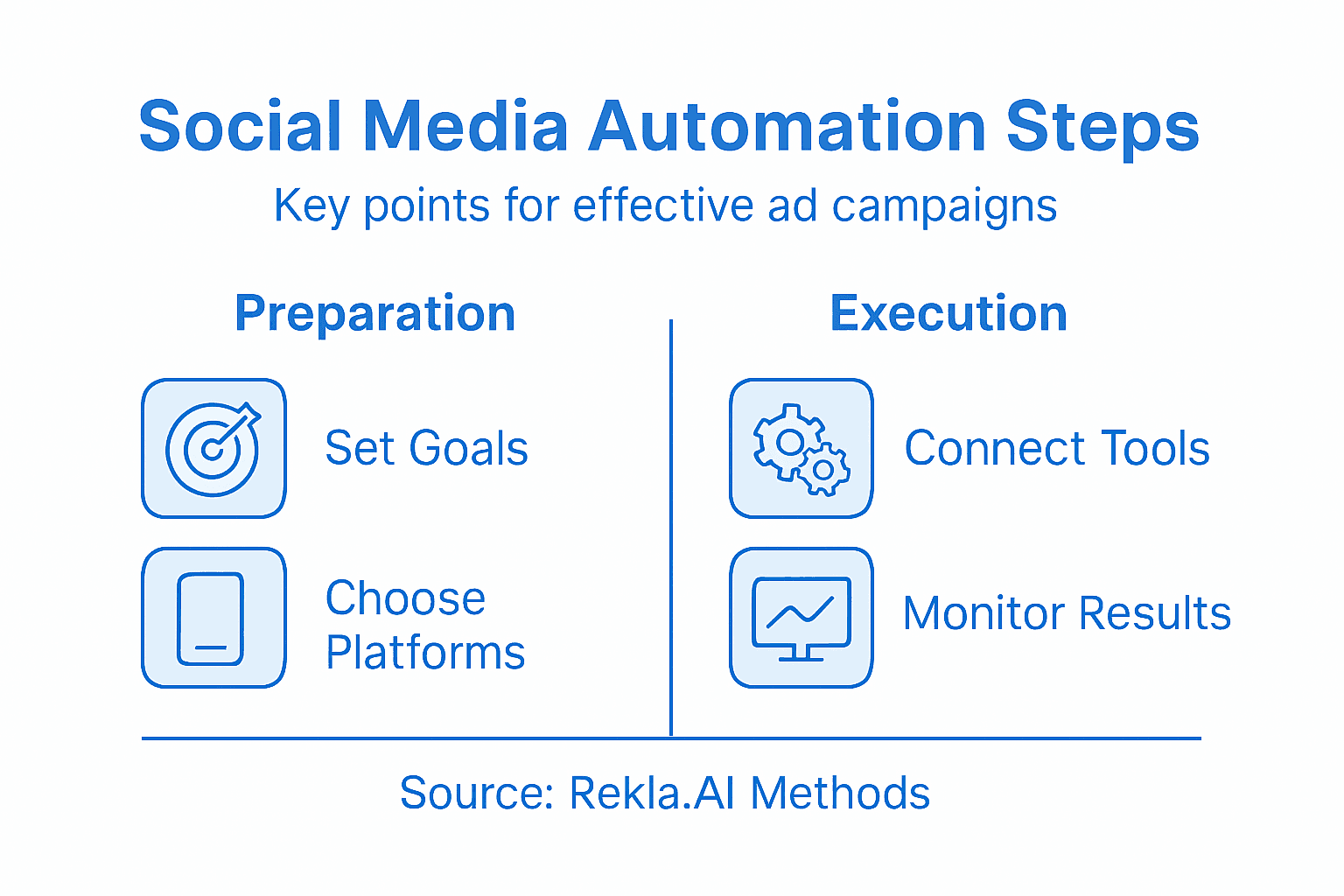
AI-powered monitoring platforms offer intelligent insights for swift campaign optimization. Implement a systematic approach to analyzing performance data by comparing current metrics against your initial benchmarks. Look for patterns in audience response and be prepared to make real-time adjustments to targeting, ad creative, and budget allocation. Set up automated alerts that notify you of significant performance shifts, enabling rapid strategic pivots when certain ads or audience segments underperform.
Proffstips: Create a weekly performance review template with color coded indicators to quickly assess campaign health and identify immediate optimization opportunities.
Unlock Smarter Social Media Advertising with Rekla.AI
The article highlights key challenges such as connecting multiple social media accounts, automating ad scheduling, precise audience targeting, and real-time campaign optimization. These steps can feel overwhelming and time-consuming for many businesses striving to build effective social media advertising campaigns. If you want to reduce manual work, increase click-through rates, and optimize budget allocation efficiently, Rekla.AI offers the solution you need. Our AI-powered platform simplifies complex tasks like generating engaging ad creatives, automating multi-channel deployment, and delivering actionable analytics all in one user-friendly interface.
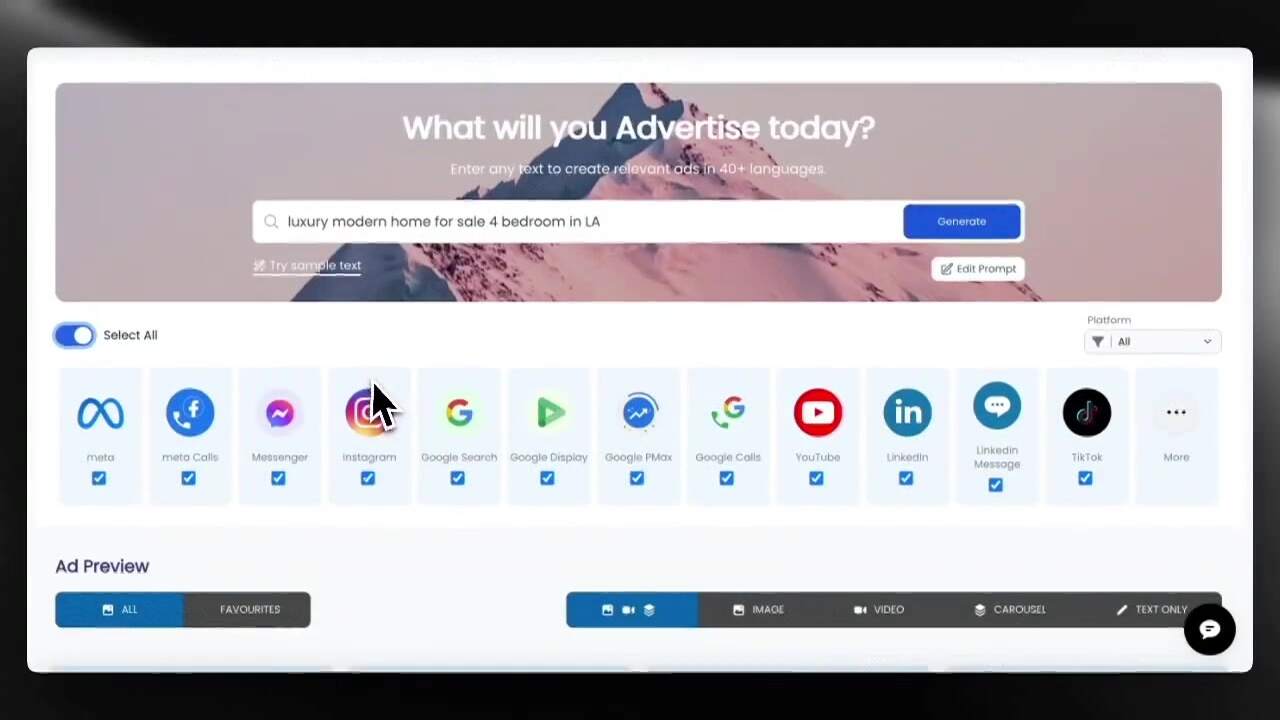
Take control of your social media advertising today by leveraging Rekla.AI’s advanced AI automation tools. Whether you are focused on defining target audiences, scheduling content strategically, or monitoring campaign performance to maximize ROI, Rekla.AI provides everything you need to launch smarter campaigns faster. Explore how our platform can help you automate and optimize across Facebook, LinkedIn, TikTok, and over a dozen more platforms by visiting Rekla.AI. Start transforming your digital advertising strategy now with AI-powered advertising automation designed for real results.
Vanliga frågor
What are the first steps to setting up social media automation for ad campaigns?
Start by identifying your business goals and selecting the appropriate social media platforms. Define specific marketing objectives, such as brand awareness or lead generation, then research platform user demographics to match your audience effectively.
How can I integrate my social media accounts into an automation platform?
To integrate your accounts, select a comprehensive automation platform that supports your identified social networks. Connect each business account securely, ensuring all permissions are correctly set, and test functionality for tasks like post scheduling and performance tracking.
What factors should I consider when defining my target audience for ads?
Consider demographic characteristics, interests, and online behaviors when defining your target audience. Segment your potential customers into distinct groups based on these factors to tailor your messaging effectively and drive engagement.
How do I allocate my advertising budget across different social media platforms?
Allocate your advertising budget by starting with a conservative initial distribution across various platforms. Monitor the performance closely and adjust your spending strategy to invest more in channels that show higher engagement and conversion rates, making changes every few weeks as needed.
How can I ensure my ad content is engaging for my target audience?
Create diverse ad content that resonates with your audience by incorporating visually appealing images and clear calls to action. Use a content calendar to schedule and track content effectiveness, allowing you to adapt based on audience feedback and performance metrics.
What metrics should I track to optimize my social media advertising campaigns?
Focus on tracking key performance indicators that align with your business objectives, such as conversion rates and return on ad spend. Use these metrics to evaluate campaign success and make real-time adjustments to targeting, creative content, and budget allocation as needed.
Rekommenderas
- #1 Plattform för AI-annonsering och automatisering av sociala medier 2025
- Starta din första AI-drivna annonskampanj - en steg-för-steg-guide
- Starta din första AI-drivna annonskampanj - en steg-för-steg-guide
- Automatisering av sociala medier görs enkelt med #1 AI Post Generator
- Rollen av sociala medier för företag: Tillväxt, engagemang och varumärke
 English
 English (UK)
 Polski
 Deutsch
 Español
 Français
 Português
 Svenska
 Dansk
Dansk Nederlands