

Launching a digital marketing campaign can feel overwhelming when goals are unclear and resources are tight. Getting your message to the right audience and achieving measurable results often requires more than just good intentions—it takes strategy and adaptability. The right roadmap helps you focus your efforts and avoid wasted time or budget.
This list reveals actionable steps to organize your digital marketing, from setting specific campaign objectives to building audience segments and harnessing AI for personalized ad content. You’ll find practical methods that help you plan smarter, spend more efficiently, and get real-time feedback. Get ready to discover proven strategies used by leading marketers to drive real results and maximize every advertising opportunity.
Table of Contents
- 1. Define Clear Campaign Objectives And Kpis
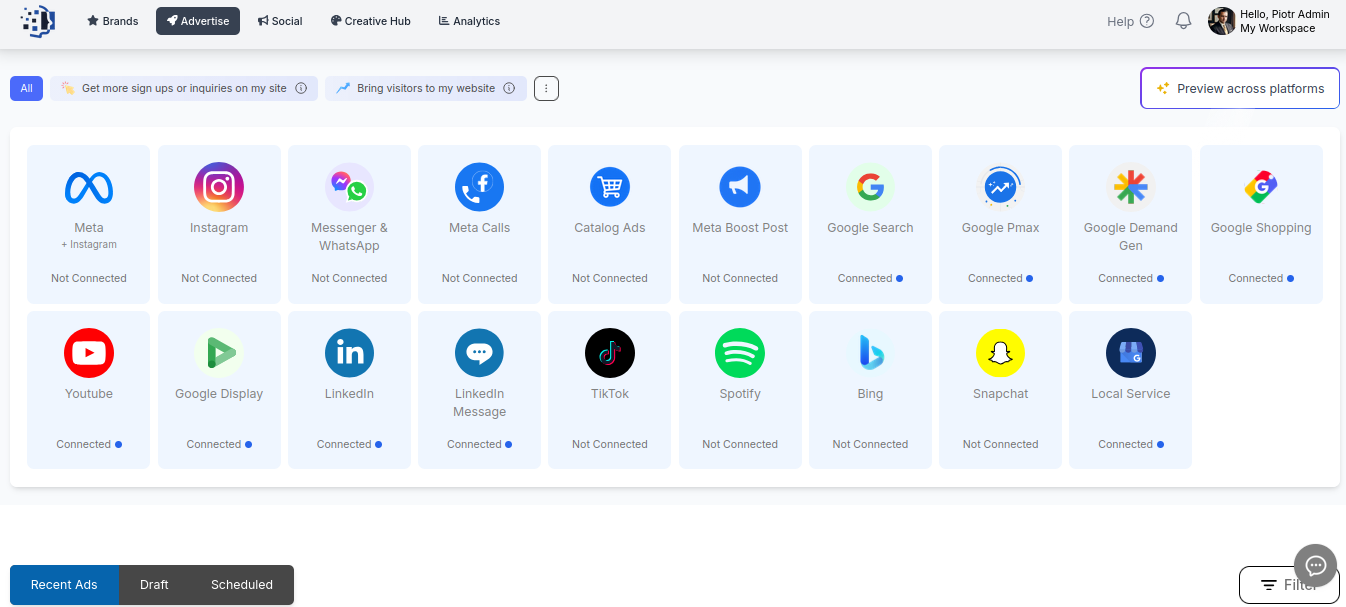
- 2. Identify And Segment Your Target Audience
- 3. Utilize Ai For Automated Ad Creative Generation
- 4. Choose Strategic Multi-Channel Ad Placement
- 5. Set Up Smart Budget Allocation And Management
- 6. Run A/B Tests To Optimize Performance
- 7. Monitor Analytics And Adjust In Real Time
Quick Summary
| Takeaway | Explanation |
|---|---|
| 1. Define clear campaign objectives. | Establish precise goals and align them with business outcomes to enhance campaign effectiveness. |
| 2. Segment your target audience. | Use detailed buyer personas for precise targeting, improving engagement and campaign efficiency. |
| 3. Utilize AI for ad creation. | Leverage AI to generate personalized ad content quickly, reducing costs while increasing engagement potential. |
| 4. Choose multi-channel ad placement. | Diversify ad placement across platforms to create multiple touchpoints and reinforce brand messaging. |
| 5. Monitor analytics in real time. | Track performance metrics actively to make immediate adjustments, optimizing campaign outcomes dynamically. |
1. Define Clear Campaign Objectives and KPIs
Successful digital marketing campaigns start with crystal clear objectives and well-defined key performance indicators (KPIs). Without precise goals, your advertising efforts become scattered and ineffective.
Defining campaign objectives is more than just picking random metrics. It requires a strategic approach that aligns your marketing goals with broader business outcomes. By establishing SMART marketing objectives, you create a roadmap for measurable success.
Key elements of effective campaign objectives include:
- Specificity about what you want to achieve
- Measurable targets that can be tracked
- Realistic and achievable goals
- Direct relevance to your business strategy
- Time-bound parameters for evaluation
Clear objectives transform vague marketing attempts into precision-driven campaigns that deliver tangible results.
When establishing KPIs, focus on metrics that directly reflect your campaign’s core purpose. For instance, if brand awareness is your goal, track metrics like reach, impressions, and engagement rates. For conversion-focused campaigns, prioritize click-through rates, conversion rates, and cost per acquisition.
Typical digital marketing KPIs to consider:
- Return on ad spend (ROAS)
- Customer acquisition cost
- Conversion rate
- Click-through rate
- Engagement metrics
Pro tip: Regularly review and adjust your KPIs to ensure they remain aligned with evolving business objectives and market conditions.
2. Identify and Segment Your Target Audience
Understanding your target audience is the cornerstone of effective digital marketing. Without precise audience insights, your campaigns will miss the mark and waste valuable advertising resources.
Audience segmentation goes beyond basic demographics. Developing detailed buyer personas allows you to create highly targeted marketing strategies that resonate with specific customer groups.
Key audience segmentation dimensions include:
- Demographic characteristics such as age and income
- Geographic location and regional preferences
- Behavioral patterns and purchasing habits
- Psychographic factors like interests and lifestyle
Precision targeting transforms generic advertising into personalized communication that speaks directly to your ideal customers.
To effectively segment your audience, start by collecting comprehensive data through:
- Customer surveys
- Website analytics
- Social media insights
- Purchase history
- Interaction tracking
Advanced digital marketing strategies leverage precision audience targeting to maximize campaign efficiency. By understanding granular audience details, you can craft messages that feel individually crafted.
Pro tip: Regularly update your audience segments as consumer behaviors and market dynamics continuously evolve.
3. Utilize AI for Automated Ad Creative Generation
Artificial intelligence has revolutionized digital advertising by transforming how marketers create compelling ad content. AI-powered ad creative generation enables businesses to produce personalized, high-performing advertisements faster than ever before.
Traditional ad creation is time-consuming and expensive. AI changes the game by generating multiple creative variations rapidly, tailoring content to specific audience segments and increasing engagement potential.
Key benefits of AI-driven ad creative generation include:
- Rapid content production at scale
- Personalized visual designs
- Reduced creative development costs
- Enhanced targeting precision
- Consistent brand messaging
AI turns generic advertising into a precision instrument for customer connection.
Successful AI ad creative generation requires strategic implementation. Marketers should leverage AI tools that can:
- Analyze existing brand assets
- Generate multiple design variations
- Predict potential audience engagement
- Optimize creative elements dynamically
- Provide performance insights
AI advertising technologies now enable smarter content creation by understanding complex user preferences and generating contextually relevant advertisements.
Pro tip: Continuously test and refine AI-generated creatives to improve performance and maintain brand authenticity.
4. Choose Strategic Multi-Channel Ad Placement
Successful digital marketing requires a sophisticated approach to ad placement across multiple platforms. Multi-channel advertising strategies enable businesses to maximize campaign reach and engagement.
No single advertising platform can deliver comprehensive audience coverage. By diversifying your ad placement, you create multiple touchpoints that reinforce your brand message and increase conversion potential.
Key considerations for strategic multi-channel placement include:
- Audience demographic alignment
- Platform performance metrics
- Budget optimization
- Content format compatibility
- Cross-platform messaging consistency
Effective multi-channel advertising transforms scattered efforts into a unified marketing ecosystem.
Strategic ad placement involves carefully selecting complementary channels:
- Social media platforms
- Search engine networks
- Display advertising networks
- Video streaming services
- Audio podcast channels
Cross-platform ad management requires understanding each platform’s unique strengths and audience behaviors. Analyze performance data continuously to refine your approach and allocate resources more effectively.
Pro tip: Develop platform-specific content variations that maintain your core message while adapting to each channel’s unique audience expectations.
5. Set Up Smart Budget Allocation and Management
Effective digital marketing requires intelligent budget management that maximizes return on investment. Strategic budget allocation transforms limited resources into powerful marketing opportunities.
Traditional budget approaches often lead to inefficient spending and unpredictable results. Modern digital marketers need dynamic strategies that adapt quickly to performance data and market changes.
Key principles of smart budget management include:
- Flexible spending models
- Data-driven decision making
- Performance-based allocation
- Real-time budget adjustments
- Channel-specific optimization
Smart budget management turns marketing expenses into strategic investments.
Implement budget allocation through these critical steps:
- Define clear campaign objectives
- Analyze historical performance data
- Assign initial channel budgets
- Monitor performance metrics
- Redistribute funds based on results
Advanced budget allocation techniques leverage artificial intelligence to predict and optimize spending across different marketing channels. This approach allows for more precise and responsive financial management.
Pro tip: Allocate 10-20% of your budget as a flexible “testing fund” to experiment with emerging channels and innovative marketing strategies.
6. Run A/B Tests to Optimize Performance
Successful digital marketing campaigns demand continuous refinement through systematic testing. A/B testing strategies provide a scientific approach to improving marketing performance.
A/B testing allows marketers to make data-driven decisions by comparing two versions of a campaign element to determine which performs better. This method eliminates guesswork and emotional decision-making.
Key elements to test in digital marketing include:
- Ad headline variations
- Call-to-action wording
- Visual design elements
- Image and video content
- Landing page layouts
Precision testing transforms marketing from art to measurable science.
Effective A/B testing requires a structured approach:
- Develop a clear hypothesis
- Isolate a single variable
- Define success metrics
- Split audience randomly
- Collect statistically significant data
- Implement winning variation
When running digital ad optimization tests, ensure you have enough sample size and run tests long enough to generate meaningful insights. Small changes can lead to significant performance improvements.
Pro tip: Maintain a testing log to track experiments, documenting hypotheses, results, and learnings to build institutional knowledge over time.
7. Monitor Analytics and Adjust in Real Time
Successful digital marketing requires continuous performance monitoring and immediate strategic adjustments. Real-time analytics enable precision marketing by providing instant insights into campaign performance.
Traditional marketing approaches relied on retrospective analysis. Modern digital marketers leverage dynamic data tracking to make immediate campaign modifications that optimize results.
Key analytics monitoring aspects include:
- Conversion rate tracking
- Click-through performance
- Audience engagement metrics
- Cost per acquisition
- Return on ad spend
Intelligent marketing means transforming data into immediate strategic action.
Effective real-time monitoring involves:
- Set up comprehensive tracking dashboards
- Define critical performance indicators
- Create automated alert systems
- Develop rapid response protocols
- Implement continuous optimization strategies
By tracking social media analytics, marketers can understand consumer behavior and make precise campaign adjustments that improve overall performance.
Pro tip: Schedule daily 15-minute analytics reviews to catch performance trends early and make swift, data-driven campaign adjustments.
Below is a comprehensive table summarizing the main strategies and their implementations for effective digital marketing campaigns as discussed throughout the provided article.
| Strategy | Implementation | Expected Outcomes |
|---|---|---|
| Define Clear Campaign Objectives and KPIs | Set specific, measurable, achievable, relevant, and time-bound objectives aligned with business goals. | Facilitates measurable and targeted campaign effectiveness. |
| Identify and Segment Target Audiences | Develop detailed buyer personas using demographic, geographic, behavioral, and psychographic data. | Enhances relevance and personalization in marketing efforts. |
| Utilize AI for Automated Ad Creative Generation | Deploy AI tools for rapid and tailored creation of ad creatives while maintaining cost efficiency and performance. | Produces high-performing, audience-specific advertisements efficiently. |
| Choose Strategic Multi-Channel Ad Placement | Analyze audience and platform dynamics; implement campaigns across complementary channels for broader reach. | Boosts audience engagement and campaign reach through diversified platforms. |
| Set Up Smart Budget Allocation and Management | Use performance data and adaptive spending frameworks to optimize resource use and ROI effectively. | Maximizes profitability and minimizes resource wastage. |
| Run A/B Tests to Optimize Performance | Perform controlled tests on individual campaign elements to identify optimal variations. | Improves campaign performance and conversion rates systematically. |
| Monitor Analytics and Adjust in Real Time | Utilize real-time data tracking to evaluate KPIs consistently and refine campaign strategies dynamically. | Ensures timely adjustments to enhance marketing efficiency and results. |
Elevate Your Digital Marketing with AI-Powered Precision
The “7 Step Digital Marketing Checklist for Smarter Campaigns” highlights the essential challenges marketers face such as defining clear objectives, segmenting audiences, optimizing budgets, running A/B tests, and making data-driven adjustments in real time. These pain points show the need for a solution that simplifies complex campaign management while delivering measurable results. Rekla.AI answers this call with a powerful platform that automates ad creative generation using artificial intelligence, sharpens audience targeting, and streamlines multi-channel ad placement so you can focus on driving conversions and maximizing ROI.
By leveraging AI-driven automated ad creation and real-time campaign optimization, Rekla.AI empowers small to medium businesses and digital marketers to conquer challenges like budget management and performance monitoring effortlessly. Rekla.AI’s intuitive interface brings advanced marketing tools to your fingertips, enabling smarter decisions without the need for prior ad expertise. Let Rekla.AI help you transform your digital campaigns into precise, impactful marketing efforts.
Start enhancing your marketing results today. Discover how AI technology can simplify your campaign process and boost returns by visiting Rekla.AI.
Frequently Asked Questions
What are the key campaign objectives I should set for my digital marketing?
Defining clear campaign objectives is crucial for success. Start by creating Specific, Measurable, Achievable, Relevant, and Time-bound (SMART) goals tailored to your business strategy within the first week of your campaign.
How can I best identify and segment my target audience?
To effectively segment your target audience, gather detailed data on demographics, behavior, and interests. Use customer surveys and website analytics to create detailed buyer personas within 30 days to ensure your marketing messages resonate.
How can I utilize AI for ad creative generation?
Leverage AI tools to automate and personalize your ad content quickly. Start by analyzing your existing brand assets and generating multiple creative variations to enhance audience engagement within the first week of implementation.
What are effective methods for multi-channel ad placement?
Choose advertising platforms strategically by understanding your audience’s preferences across various channels. Aim to diversify your ad placements within 14 days to create multiple touchpoints for reinforcing your brand message.
What steps should I take for smart budget allocation in digital marketing?
Employ flexible spending models and data-driven decision-making for budget management. Start allocating budgets based on performance metrics and adjust funds in real-time to optimize your investment within the first month.
How do I set up A/B testing to optimize my marketing performance?
To run effective A/B tests, start by developing a clear hypothesis about the element you wish to test, such as ad headlines or call-to-action wording. Isolate one variable and collect significant data over a two-week period to determine the best-performing variant.
Recommended
- Digital Advertising Workflow Guide: Streamline Campaign Creation
- 7 Essential Steps for a Social Media Ad Checklist
- 7 Essential Steps for a Social Media Ad Checklist
- Digital Ad Campaign Basics: Powering Smart ROI
- 7 Proven Tactics: What Is the Best Marketing Strategy?
- 7-Step SEO Checklist for Small Businesses Success
 English
 English (UK)
 Polski
 Deutsch
 Español
 Français
 Português
 Svenska
 Dansk
Dansk Nederlands