

Many small business owners believe media buying is reserved for corporations with million-dollar budgets. That’s outdated thinking. AI-driven tools have leveled the playing field, making sophisticated media buying accessible to SMBs. In fact, 60% of SMBs using AI-driven media buying report improved ad performance within 3 months. This article shows you how to leverage AI-powered media buying strategies to boost your ROI and reduce the time you spend managing campaigns.
Indholdsfortegnelse
- Introduction To Media Buying
- Role Of AI In Media Buying
- Comparison Of Traditional Vs AI-Powered Media Buying
- Practical Application: Using AI Tools Like Rekla.AI For Media Buying
- Key Metrics And Success Indicators In AI-Driven Media Buying
- Optimize Your Media Buying With Rekla.AI Automation
- Ofte stillede spørgsmål
Vigtige pointer
| Punkt | Detaljer |
|---|---|
| AI democratizes media buying | Small businesses now access enterprise-level media buying tools through AI automation, eliminating budget barriers. |
| Programmatic buying outperforms manual methods | AI-powered real-time bidding delivers better precision and cost efficiency than traditional approaches. |
| Multi-channel management expands reach | AI tools coordinate campaigns across 15+ platforms simultaneously, maximizing audience coverage. |
| Key metrics drive optimization | Tracking CTR, ROAS, and cost per acquisition enables continuous AI-driven campaign refinement. |
| Time savings reach 50% | Automation reduces manual campaign management effort by half while improving performance. |
Introduction to Media Buying
Media buying is the process of purchasing advertising space and time across digital channels to place your ads where your target audience spends their attention. For SMBs, effective media buying determines whether your marketing budget generates revenue or disappears into ineffective placements. You’re competing for the same eyeballs as major brands, but you can’t afford to waste money on poorly targeted ads.
The role of AI in SMB marketing has transformed this landscape entirely. Most small businesses now allocate over 50% of their advertising budget to media buying activities. Without automation, you face overwhelming complexity: multiple platforms with different interfaces, constantly changing algorithms, and the need to monitor campaigns in real time.
Traditional media buying creates specific challenges for SMBs:
- Platform fragmentation forces you to manage separate campaigns across Google, Facebook, Instagram, LinkedIn, and emerging channels
- Manual bid adjustments consume hours each week and still miss optimal timing
- Budget allocation decisions require constant attention and data analysis
- Audience targeting relies on guesswork rather than data-driven insights
The result? Many SMBs waste 30 to 40% of their ad spend on poorly optimized campaigns. Your ads reach the wrong people at the wrong time, or you overpay for placements that deliver minimal return. AI-powered media buying solves these problems by automating the decisions that traditionally required expert knowledge and constant monitoring.
Role of AI in Media Buying
AI technology transforms media buying from a manual, time-intensive process into an automated system that makes split-second optimization decisions. Machine learning algorithms analyze millions of data points to determine the best ad placements, bid amounts, and audience segments for your campaigns. This happens continuously, adjusting your strategy based on real-time performance data.
The impact on SMB advertising is substantial. Research shows AI automation can boost digital ad ROI by up to 30% while reducing campaign management time by 40%. You’re not just saving time; you’re getting better results because AI identifies patterns and opportunities humans miss.
Here’s what AI handles automatically:
- Dynamic bid adjustments that respond to competition and conversion likelihood in milliseconds
- Budget reallocation across platforms based on real-time performance metrics
- Audience segmentation using behavioral data and predictive modeling
- Ad placement optimization across thousands of potential inventory options
- A/B testing at scale with statistical significance analysis
Pro Tip: Start with AI automation for your highest-volume campaigns where small percentage improvements translate to significant dollar savings. The data AI collects here will improve performance across all your advertising.
The shift to social media automation with AI means you can compete with larger advertisers who previously had advantages in expertise and resources. Your AI tools make the same quality decisions as enterprise marketing teams, but at a fraction of the cost. The playing field isn’t just leveled; it’s tilted in favor of agile SMBs who adopt these technologies quickly.

Comparison of Traditional vs AI-Powered Media Buying
Understanding the gap between manual and AI-driven approaches clarifies why automation delivers superior results. Traditional media buying requires marketers to manually research audiences, set bids, monitor performance, and adjust campaigns based on periodic reporting. This creates delays between performance changes and your response.
| Aspekt | Traditional Media Buying | AI-Powered Programmatic Buying |
|---|---|---|
| Bid Management | Manual adjustments based on daily or weekly reviews | Real-time automated bidding optimized per impression |
| Målretning mod målgruppen | Broad demographic segments with limited refinement | Behavioral and predictive modeling with micro-segmentation |
| Tildeling af budget | Fixed distribution requiring manual rebalancing | Dynamic reallocation based on performance algorithms |
| Response Time | Hours to days for campaign adjustments | Milliseconds for bid and placement optimization |
| Scale Capacity | Limited by human bandwidth and expertise | Unlimited scaling across platforms and campaigns |
The cost implications are significant. Programmatic AI-based media buying offers better cost efficiency and precision through automated real-time bidding. When you reduce ad costs with AI, you’re not cutting corners; you’re eliminating waste by paying optimal prices for ad inventory.
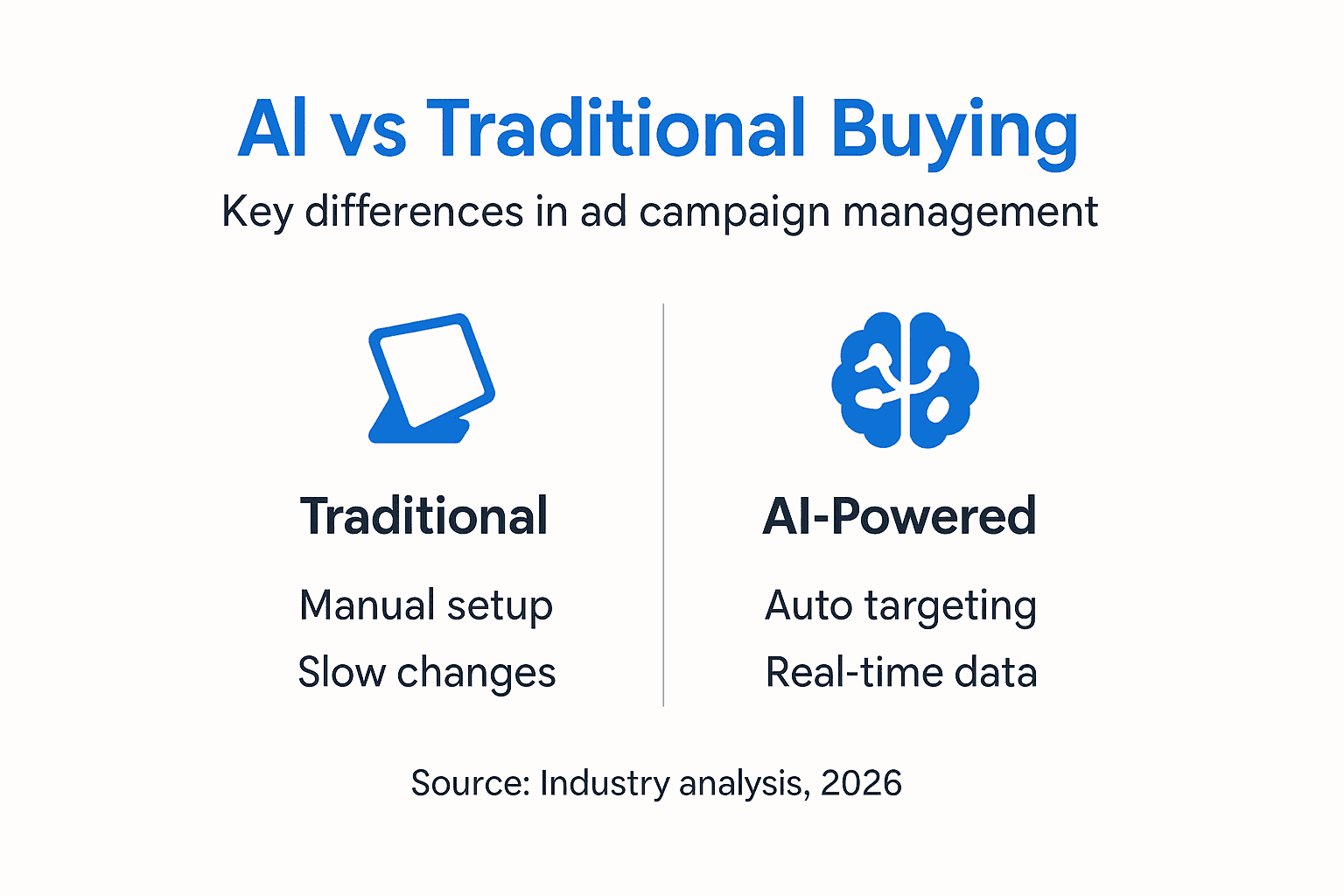
Consider a practical example. You run a Facebook ad campaign targeting small business owners interested in marketing automation. Traditional buying sets a fixed bid and demographic target. AI-powered buying analyzes individual user behavior, time of day patterns, device preferences, and conversion likelihood to adjust bids for each impression. One user might see your ad when AI determines they’re 73% likely to convert, justifying a higher bid. Another sees it during low-intent browsing, warranting a minimal bid.
Pro Tip: When you optimize ad spend, focus on platforms where AI has the richest data sets. Facebook and Google offer the most sophisticated programmatic options for SMBs.
This precision eliminates the spray-and-pray approach that drains SMB marketing budgets. You pay premium rates only for high-value opportunities while maintaining brand presence during lower-intent moments at minimal cost.
Practical Application: Using AI Tools like Rekla.AI for Media Buying
Theory means nothing without implementation. Here’s how you actually use AI-powered platforms to execute media buying campaigns that deliver measurable results.
- Campaign Planning and Setup: Log into your AI platform and define campaign objectives using natural language. Instead of configuring complex targeting parameters, describe your ideal customer. The AI translates this into precise audience segments across multiple platforms.
- Audience Targeting Configuration: Upload your customer data or connect your CRM. The AI builds lookalike audiences and identifies behavioral patterns that predict conversion likelihood. This happens across Facebook, Google, LinkedIn, Instagram, TikTok, and 10+ other platforms simultaneously.
- Creative Asset Generation: Use AI to generate multiple ad variations optimized for each platform’s specifications. The system creates headlines, body copy, and suggests imagery based on what performs best in your industry.
- Budget and Bid Strategy: Set your total budget and desired ROI target. The AI automatically distributes spending across platforms and adjusts bids to maximize return while staying within your constraints.
- Launch and Automated Optimization: Activate your campaign. The AI begins testing variations, adjusting bids, and reallocating budget based on real-time performance data. You receive alerts only when significant trends emerge or manual decisions are needed.
Real-world results validate this approach. SMBs report up to 50% time savings on campaign management using Rekla.AI. That’s 10 to 20 hours per week you redirect to strategy and business development instead of manual campaign babysitting.
A boutique consulting firm used cross-platform ad management to run simultaneous campaigns across Google Search, LinkedIn, and Facebook. Previous manual management required three separate dashboards and daily monitoring. With AI automation, they set parameters once and let the system optimize. Their cost per lead dropped 34% in the first month while lead volume increased 22%.
Key automation features that drive these results:
- Dynamic budget reallocation shifts spending from underperforming platforms to high-ROI channels automatically
- Creative rotation testing identifies winning variations without manual A/B test management
- Audience expansion discovers new customer segments based on conversion patterns
- Bid optimization adjusts pricing thousands of times per day based on competition and conversion likelihood
The digital campaign setup guide approach eliminates the technical barriers that previously kept SMBs from sophisticated media buying. You don’t need to understand programmatic advertising mechanics. The AI handles complexity while you focus on business outcomes.
Understanding the fordele ved automatisering af annoncer helps you set realistic expectations. You’ll see incremental improvements in the first weeks, with substantial gains appearing after the AI accumulates sufficient performance data, typically 30 to 60 days.
Key Metrics and Success Indicators in AI-Driven Media Buying
Measuring what matters separates successful campaigns from budget drains. AI tools track dozens of metrics, but you need to focus on indicators that directly correlate with business outcomes.
The essential KPIs for SMB media buying:
- Click-Through Rate (CTR): Measures ad relevance and creative effectiveness. Industry average is 2 to 3%, but AI optimization typically achieves 4 to 6% for targeted B2B campaigns.
- Return on Ad Spend (ROAS): Calculates revenue generated per dollar spent. Aim for minimum 3:1 ROAS, though profitable thresholds vary by industry and customer lifetime value.
- Omkostninger pr. erhvervelse (CPA): Tracks how much you spend to gain each customer. Compare this to customer lifetime value to ensure sustainable growth.
- Konverteringsfrekvens: Percentage of clicks that become customers. AI targeting improvements often double baseline conversion rates.
- Impression Share: Shows what percentage of available impressions your ads captured. Reveals whether budget constraints limit your reach.
AI significantly enhances tracking of KPIs like CTR and ROAS, enabling data-driven optimization. Real-time dashboards update continuously, showing performance trends before they impact your budget significantly.
| Metrisk | Manual Tracking | AI-Automated Tracking |
|---|---|---|
| Data Freshness | Daily or weekly reports | Real-time continuous updates |
| Granularity | Campaign or ad group level | Individual ad and audience segment level |
| Predictive Analysis | None | Forecasts performance trends 7 to 30 days ahead |
| Anomaly Detection | Manual review required | Automatic alerts for unusual patterns |
| Cross-Platform | Separate reports per platform | Unified dashboard across all channels |
The impact on decision quality is substantial. Machine learning cuts SMB ad costs by 60% in 2026 by optimizing key metrics through continuous micro-adjustments humans can’t execute manually. When your machine learning cuts SMB ad costs, the savings compound over time as algorithms learn your specific audience behaviors.
A digital advertising strategy guide approach means reviewing these metrics weekly rather than daily. AI handles tactical adjustments; you focus on strategic decisions like budget increases, new market entry, or creative direction changes.
Pro Tip: Set up automated weekly reports that highlight only metrics outside your target ranges. This focuses your attention on campaigns needing strategic input while AI manages everything performing within parameters.
AI’s role in SMB marketing success centers on translating raw data into actionable insights. You see which audience segments deliver highest value, which platforms waste budget, and which creative approaches resonate. These insights inform not just media buying but your entire marketing strategy.
Optimize Your Media Buying with Rekla.AI Automatisering
You’ve seen how AI transforms media buying from a complex, time-consuming process into an automated system that delivers superior results. The question now is implementation. Rekla.AI provides the complete automation platform SMBs need to compete effectively in digital advertising.
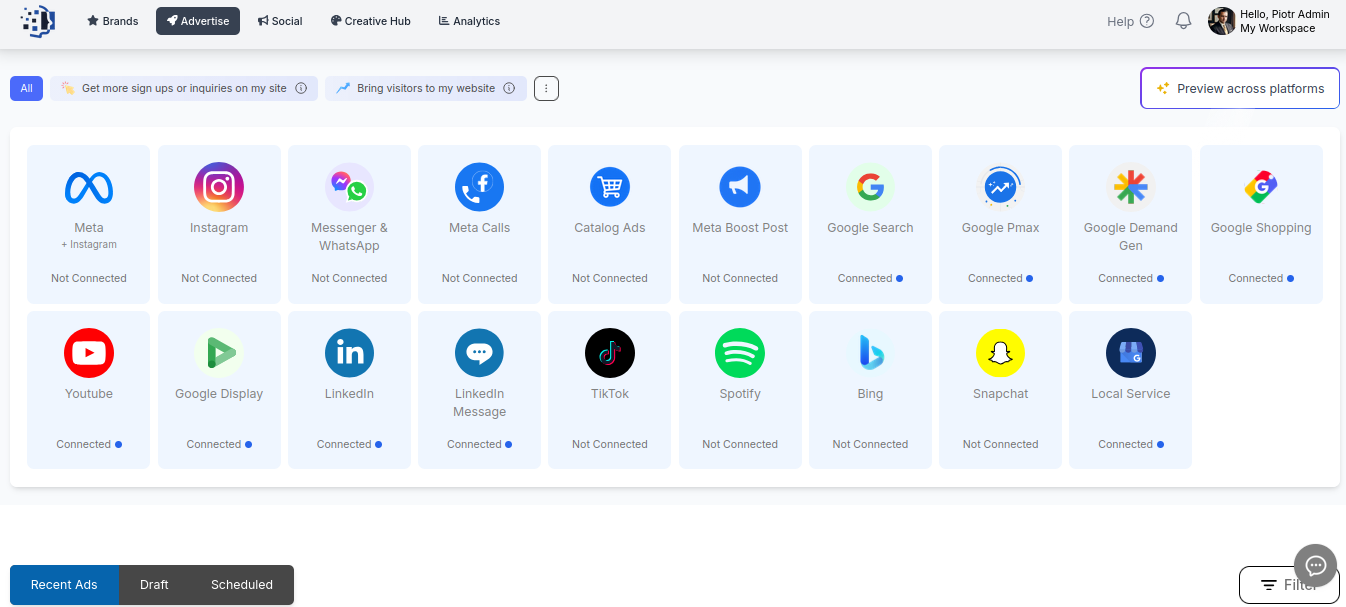
The platform handles everything discussed in this article: campaign creation across 15+ channels, intelligent audience targeting using behavioral data, dynamic budget allocation based on real-time performance, and comprehensive analytics that guide strategic decisions. You get enterprise-level automatisering af reklamer capabilities without enterprise complexity or cost.
Real SMBs save 50% of their campaign management time while improving ROI by 30% or more. The benefits of ad automation extend beyond efficiency. You gain consistency across campaigns, eliminate human error in bid management, and scale your advertising without proportionally scaling your team.
Multi-channel ad strategies that previously required agency support become manageable in-house. Your campaigns coordinate seamlessly across Google, Facebook, Instagram, LinkedIn, TikTok, YouTube, Spotify, and programmatic exchanges. The AI ensures consistent messaging while optimizing creative and targeting for each platform’s unique characteristics.
Explore how AI-powered media buying platform technology can transform your advertising results. Start with one campaign to experience the difference automation makes, then scale as you see results.
Ofte stillede spørgsmål
Can SMBs successfully use media buying without large budgets?
Yes, AI tools enable SMBs to optimize every dollar spent, often achieving better efficiency than large companies using manual methods. Small budgets benefit most from AI optimization because percentage improvements translate directly to survival versus failure. Start with budgets as low as $500 monthly and scale based on proven ROI.
How quickly can AI-powered media buying improve campaign results?
Most SMBs see measurable improvements within 30 to 45 days as AI algorithms accumulate performance data. Significant ROI gains typically appear within 60 to 90 days. The learning period varies based on campaign volume; higher traffic accelerates optimization. Early wins often come from eliminating obvious waste before sophisticated optimization begins.
What are the biggest mistakes SMBs make when adopting AI for media buying?
Over-automation without strategic oversight tops the list. AI optimizes toward the goals you set, so wrong objectives produce wrong results. SMBs also frequently neglect multi-channel coordination, running isolated campaigns when integrated approaches deliver better returns. Finally, insufficient initial data quality hampers AI effectiveness; ensure accurate conversion tracking before expecting optimization miracles.
Which platforms can I buy ads on using AI media buying tools?
Top platforms include Google Ads, Facebook, Instagram, LinkedIn, TikTok, YouTube, Spotify, Twitter, Pinterest, and programmatic exchanges that cover thousands of websites. Most AI tools manage 15 to 20+ platforms from a single dashboard. Focus initially on platforms where your audience concentrates, typically 3 to 5 channels, then expand based on performance data.
How do I measure success in AI-driven media buying?
Focus on business outcomes, not vanity metrics. Track ROAS, CPA, and conversion rate as primary indicators. Monitor CTR and impression share as diagnostic metrics that explain primary KPI changes. Use AI analytics to identify which audiences, creatives, and platforms drive results, then double down on winners while cutting losers. Review strategic performance weekly; let AI handle daily tactical optimization.
 English
 English (UK)
 Polski
 Deutsch
 Español
 Français
 Português
 Svenska
 Dansk
Dansk Nederlands