

Every e-commerce owner has felt the frustration of wasted ad spend on the wrong audience. Understanding how ad targeting strategies actually impact your bottom line is crucial, especially with so many myths making things confusing. With the rise of artificial intelligence, business owners see new ways to sharpen their targeting, but challenges like privacy rules and shifting customer behavior still shape results. You will uncover what really drives effective, cost-saving ad targeting in today’s complex, AI-powered environment.
Índice
- Defining Ad Targeting Strategies And Myths
- Key Types Of Audience Segmentation Methods
- How AI Optimizes Ad Targeting Precision
- Cross-Platform Targeting Tactics Explained
- Common Mistakes That Increase Ad Spend
Principais conclusões
| Ponto | Detalhes |
|---|---|
| Effective Ad Targeting | Smart targeting enhances ROI by reaching the most likely customers, avoiding wasteful spending on uninterested audiences. |
| Myths of Precision | Hyper-precision does not always equate to better profitability; consumer privacy and ad fatigue can hinder results. |
| Segmentation Strategies | Use a mix of demographic, behavioral, psychographic, and micro-segmentation for optimized audience targeting. |
| Cross-Platform Coordination | Unified campaigns across platforms improve message consistency and conversion rates, maximizing ad spend effectiveness. |
Defining Ad Targeting Strategies and Myths
Ad targeting strategies form the backbone of successful digital campaigns, yet many business owners operate under false assumptions about how they actually work. At its core, segmentação de anúncios means showing your ads to specific audiences based on their characteristics, behaviors, interests, or demographics. It sounds straightforward, but the reality is far more nuanced than “the more targeted, the better.”
The difference between a targeted approach and a shotgun approach is significant. Instead of broadcasting your product to everyone online, you’re directing your ad spend toward people most likely to buy from you. For an e-commerce business selling sustainable clothing, this might mean targeting environmentally conscious consumers aged 25-45 who follow eco-friendly brands. Without targeting, you’d waste money showing ads to people with zero interest in what you’re selling. With proper targeting, your cost per acquisition drops, your conversion rates climb, and your overall ROI improves.
But here’s where myths creep in. One of the biggest misconceptions is that hyper-precise targeting automatically leads to better profitability. Research shows that improvements in targeting accuracy don’t always translate to stronger bottom-line results. Regulatory constraints, consumer privacy concerns, and audience resistance can actually undermine even the most sophisticated targeting strategies. Someone might perfectly match your customer profile on paper, but if they’ve opted out of personalized ads or developed ad fatigue, your precision targeting becomes irrelevant.
Another common myth is that AI handles everything automatically. While artificial intelligence dramatically enhances targeting precision by analyzing vast datasets and identifying patterns humans would miss, AI in advertising requires careful oversight and isn’t a replacement for strategy. AI identifies who to target, but you still need clear business goals, ethical boundaries, and campaign structure. It’s a tool that amplifies your strategy, not a substitute for having one.
Many SME owners also believe that a single targeting strategy works across all platforms. Facebook, Google, TikTok, and LinkedIn each operate with different audience behaviors, data availability, and targeting options. A campaign that crushes it on LinkedIn might flop on TikTok with the identical targeting parameters. You need platform-specific strategies, even when your core message stays consistent.
Here’s what actually matters for targeting success. First, your data quality determines everything. Garbage input produces garbage output, regardless of AI involvement. Second, balance precision with reach. Ultra-narrow targeting reaches fewer people, which reduces total conversions even if your conversion rate is high. Third, test continuously. Your assumptions about who buys your product often don’t match reality. Fourth, respect privacy constraints. Building trust with audiences costs nothing now but saves you from regulatory headaches later.
The practical reality for your e-commerce business is this: effective ad targeting combines intelligent audience selection with flexibility, ongoing testing, and respect for consumer preferences. It’s not about finding the perfect segment and hoping for the best. It’s about using data-driven insights to make better decisions, staying adaptable as markets shift, and measuring what actually moves the needle for your business.
Dica profissional: Start with your highest-value customers and work backward to identify shared characteristics, then use those patterns as your targeting foundation instead of guessing based on demographics alone.
Key Types of Audience Segmentation Methods
Audience segmentation is how you slice your market into actionable groups. Instead of treating all potential customers as one blob, you divide them into segments that share meaningful similarities. Each segment then gets tailored messaging, offers, or creative that resonates with their specific needs. For e-commerce businesses, this difference between generic and segmented campaigns often means the gap between losing money and scaling profitably.
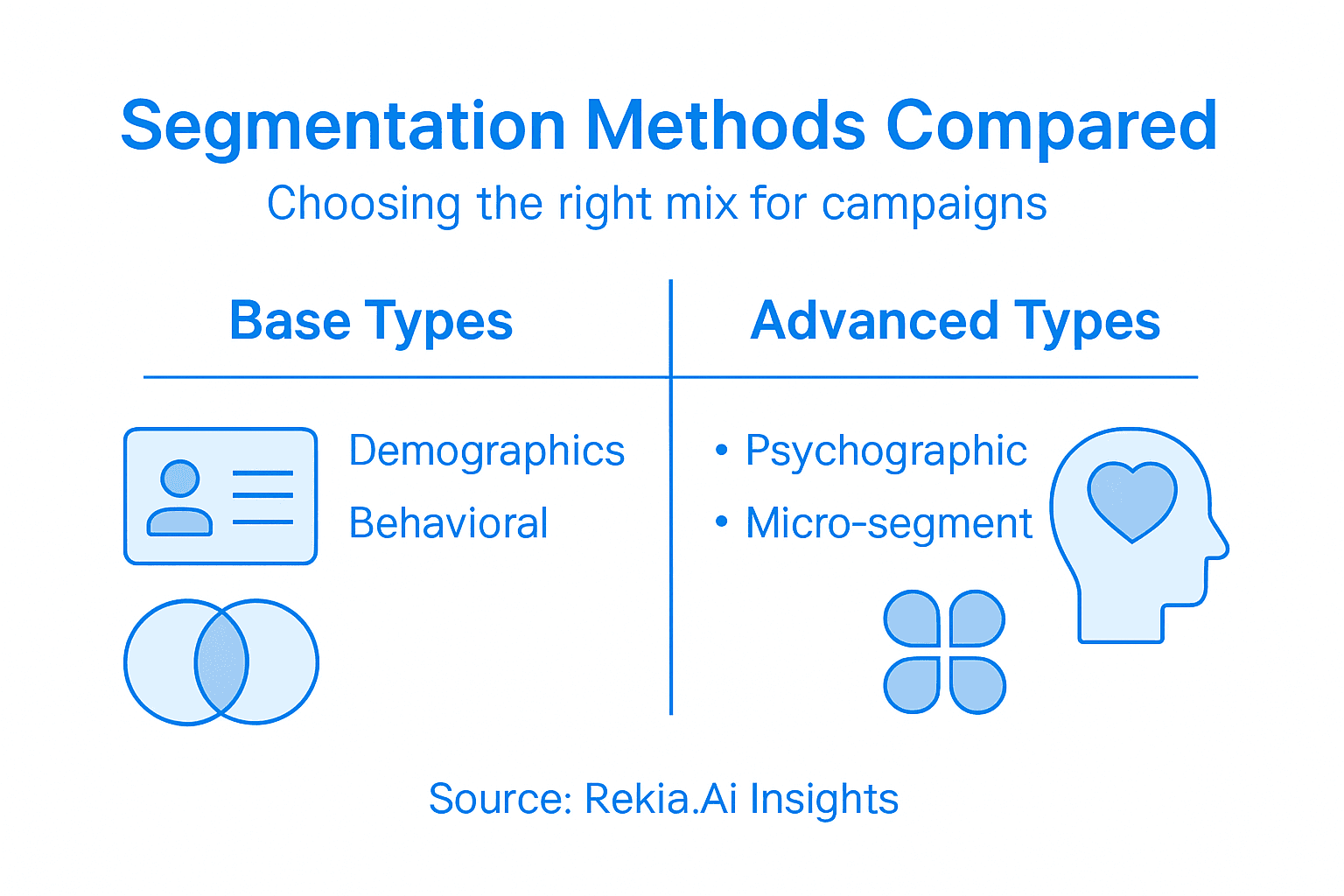
There are four primary ways to segment audiences, and understanding each one helps you choose the right mix for your campaigns. Demographic segmentation divides people by age, gender, income, location, education level, or family status. An outdoor gear retailer might target affluent males aged 35-55 in mountainous regions. It’s straightforward and uses data readily available through most advertising platforms. The limitation is that demographics alone don’t tell you much about motivation or buying behavior. Fairness perceptions around demographic targeting vary significantly, and some consumers react negatively to being categorized by race, gender, or income level, so ethical considerations matter here.
Behavioral segmentation groups people based on their actions. Purchase history, browsing patterns, cart abandonment, email engagement, and website visits all reveal real intent. Someone who clicked your product page three times but never bought signals different messaging needs than someone who bought last month but hasn’t returned. This segment shows actual behavior, not assumptions. Psychographic segmentation goes deeper into values, lifestyles, attitudes, and interests. A psychographic segment might be “environmentally conscious millennials who value sustainability and transparency.” Two people might have identical demographics but completely different psychographic profiles, resulting in entirely different purchasing motivations.
Micro-segmentation, the newest approach, combines behavioral data with advanced algorithms to create highly specific audience clusters. Instead of five or ten segments, you might have hundreds or thousands of tiny segments defined by overlapping characteristics. Algorithmic tools enable advertisers to balance efficiency with explainability across segmentation approaches, allowing platforms to create and optimize segments automatically while still remaining understandable to humans. This is where AI shines most. Machine learning algorithms identify patterns in your customer data that no human would spot manually.
Here’s how they work in practice. A sustainable fashion e-commerce brand might start with demographic segmentation to target women aged 25-40 in North America. Then behavioral segmentation narrows it further to those who visited the brand’s site in the past 60 days. Psychographic segmentation adds another filter for people who follow eco-conscious influencers and engage with sustainability content. Finally, micro-segmentation uses AI to identify which combination of these factors predicts purchase likelihood most accurately. The result is an audience that’s precisely defined but not so narrow it lacks volume.
The real power comes from combining segmentation types strategically. Demographic data provides foundation and reach. Behavioral data adds accuracy. Psychographic data adds relevance. Micro-segmentation ties it all together with algorithm-driven precision. Most successful campaigns use all four in layers, starting broad and narrowing based on data quality and business goals.
One critical point: more segmentation isn’t always better. Each additional segment requires unique creative, messaging, or offers. If you create 50 micro-segments but only have budget for generic copy, the segmentation effort wastes time. Start with two to three core segments, master them, then expand. Quality segments require quality data, and quality data requires proper tracking and integration across your platforms.
Dica profissional: Test which segmentation method drives your lowest cost per acquisition first, then layer in the others to refine targeting, rather than trying to build perfect segmentation from day one.
Here’s a comparison of the four main segmentation methods, highlighting their unique advantages and limitations:
| Segmentation Method | Foco principal | Best Use Case | Key Limitation |
|---|---|---|---|
| Demográfico | Age, gender, income | Broad targeting, initial sorting | Low relevance, stereotyping |
| Comportamental | Actions, purchase history | Retargeting, personalized offers | Missed new shoppers |
| Psicográfico | Values, attitudes, lifestyles | Brand-building, value messaging | Harder data collection |
| Micro-segmentation | Algorithmic, overlapping traits | High-volume campaigns, precision | Resource intensive |
How AI Optimizes Ad Targeting Precision
Artificial intelligence transforms ad targeting from educated guessing into scientific precision. Traditional ad targeting relies on manual rules and human assumptions about audience behavior. You pick demographics, interests, and keywords, cross your fingers, and hope the audience you selected actually converts. AI changes this equation entirely. Instead of applying static rules, AI systems continuously analyze massive amounts of consumer data, identify patterns humans would never spot, and automatically adjust targeting in real-time to maximize ROI. The difference in performance between manual and AI-driven targeting often reaches 40-60% improvement in cost per acquisition within the first few months.

Here’s how AI actually works behind the scenes. First, AI improves targeting accuracy by analyzing consumer data patterns across your entire customer base and historical campaigns. The system ingests data from multiple sources: website behavior, purchase history, email engagement, social media interactions, demographic information, and even how long someone hovers over specific products. Machine learning algorithms then identify which data points correlate most strongly with conversions. For an e-commerce store selling fitness equipment, the AI might discover that customers who viewed video content and added items to carts on mobile devices convert at 3x the rate of those who browsed on desktop. That’s a pattern no manual analysis would catch.
Next, AI segments your audience automatically based on these patterns. Rather than you manually creating 5-10 audience segments, the system creates hundreds of micro-segments, each with its own targeting profile. Machine learning applications predict consumer behaviors and optimize ad delivery in real-time, meaning that as new data comes in, segments shift and adjust continuously. Someone might start in a low-intent segment, but after they engage with specific content, the AI moves them to a high-intent segment and serves them a different offer. This constant optimization happens automatically without your intervention.
Third, AI predicts which audiences are most likely to convert before you spend money on them. The system learns your conversion patterns and applies that knowledge to new audiences you haven’t targeted before. It asks questions like: Which new website visitors resemble my best past customers? What behavioral signals indicate someone will buy in the next 72 hours? How do I identify people who won’t convert so I can exclude them from expensive ad placements? These predictions become increasingly accurate as the AI processes more campaign data.
Fourth, AI optimizes bid strategies and budget allocation automatically. Instead of setting a flat cost-per-click bid for all placements, the system adjusts bids in real-time based on conversion probability. It spends more on high-probability audiences and less on low-probability ones. For campaigns running across multiple platforms like Facebook, Google, TikTok, and LinkedIn, AI coordinates spending across all channels simultaneously, shifting budget toward whichever platform delivers the best ROI on any given day.
The practical impact for your business is significant. Without AI, you might waste 30-40% of your ad budget on audiences that convert poorly. With AI, that waste shrinks to 5-10%. Your cost per acquisition drops. Your return on ad spend climbs. Your customer acquisition becomes predictable and scalable. Most importantly, you stop relying on trial-and-error to find what works and start relying on data-driven optimization.
One critical reality: AI works best with good data. If your tracking is broken, your customer data incomplete, or your platform integrations sloppy, AI can’t work its magic. Garbage data in produces garbage optimization out. Before implementing AI-driven targeting, audit your data infrastructure. Make sure you’re capturing all relevant customer actions, that your tracking fires correctly across all devices, and that you can connect online behavior to actual purchases.
Dica profissional: Start AI optimization on your highest-volume campaign first, where the system has the most data to learn from, rather than starting with a small test campaign where the AI has insufficient data for accurate pattern recognition.
Cross-Platform Targeting Tactics Explained
Most e-commerce businesses don’t exist on just one platform. Your customers scroll Facebook in the morning, browse Google at lunch, watch TikTok at dinner, and check email before bed. Running separate, disconnected campaigns on each platform wastes money and dilutes your message. Cross-platform targeting changes this by coordinating your campaigns so they work together, not against each other. When executed properly, cross-platform strategies increase reach, improve message consistency, reduce cost per acquisition, and create compounding effects that no single-platform campaign can match.
Cross-platform targeting means your advertising strategy treats multiple platforms as one interconnected system rather than isolated channels. Cross-platform targeted advertising uses strategic collaboration across different platforms for coordinated retargeting of consumers. Here’s how this works in practice. A potential customer clicks your Facebook ad and lands on your product page but doesn’t buy. Normally, they disappear into the void. With cross-platform targeting, you’ve already set up retargeting to show them ads on Google, TikTok, and their email inbox. They see your product again on Google search results. They see a different creative angle on TikTok. They receive a personalized email with a discount code. Each touchpoint reinforces your message and moves them closer to purchase. The coordination creates what researchers call “win-win” scenarios where your conversion rate climbs, platforms get more quality engagement, and customers receive relevant messaging rather than spam.
There are several core tactics for executing cross-platform targeting effectively. First, unified audience data across platforms creates the foundation. You build a master customer database that tracks individuals across channels. When someone interacts with you on Facebook, that behavior gets recorded. When they visit your website through a Google ad, that gets recorded. When they open your email, that gets recorded. All these data points combine to create a complete picture of each customer’s journey. This unified view allows you to make smarter targeting decisions. Second, sequential messaging sequences your ads across platforms based on customer journey stage. Someone who just clicked your ad sees awareness-focused creative. After they visit your site, they see consideration-focused content. After they abandoned their cart, they see urgency-focused offers. The message evolves as the customer moves through the funnel, and the platform shifts automatically based on their behavior.
Third, frequency capping across platforms prevents ad fatigue. Without coordination, you might accidentally show the same person five Facebook ads and three Google ads in a week, creating banner blindness or resentment. Cross-platform frequency capping limits total ad exposure across all channels combined, so someone sees your brand four times weekly across all platforms rather than seeing it eight times on Facebook alone. Fourth, budget allocation orchestration automatically divides your budget across platforms based on performance. Rather than manually assigning 40 percent to Facebook, 30 percent to Google, and 20 percent to TikTok, your system watches real-time performance data and shifts budget toward whichever platform delivers the best ROI on any given day. This happens automatically without your involvement. Advanced targeting strategies using data sharing and coordinated delivery across platforms enhance campaign effectiveness by ensuring your budget goes where it performs best.
Implementing cross-platform tactics requires three foundational elements. First, robust tracking infrastructure that captures customer behavior across all channels. Second, platform integrations that allow data to flow seamlessly between your advertising platforms, email service, analytics tools, and e-commerce system. Third, centralized campaign management where you can view and adjust all platforms from one dashboard rather than switching between five different logins. Without these foundations, cross-platform coordination becomes impossible.
One practical reality: cross-platform coordination creates complexity. More platforms mean more data to manage, more integrations to maintain, and more moving parts that can break. Start with two core platforms where your audience concentrates most heavily. Master the coordination between those two. Then expand to a third platform once you’ve proven the system works. Quality coordination across three platforms beats sloppy attempts across eight.
Dica profissional: Create platform-specific audience segments based on where different customer types congregate, rather than assuming identical targeting works across all channels, since Facebook audiences behave differently than TikTok audiences even when demographically similar.
Common Mistakes That Increase Ad Spend
Every dollar wasted on advertising is a dollar that doesn’t go toward growing your business. Yet most e-commerce owners make predictable mistakes that quietly drain their ad budgets week after week. These aren’t exotic errors requiring advanced knowledge. They’re straightforward missteps that stem from incomplete understanding of how targeting actually works, false confidence in technology, or simply not measuring what matters. The good news is that once you recognize these mistakes, they become fixable.
The first major mistake is targeting too broadly. Business owners often think wider targeting increases volume and therefore conversions. In reality, broader targeting dilutes your message, increases competition for attention, and wastes budget on people unlikely to buy. You end up paying to show ads to thousands of people with zero interest in your product. A fitness equipment retailer targeting “people interested in health and fitness” reaches 100 million Americans. A fitness equipment retailer targeting “men aged 30-50 who viewed home gym equipment on the site in the past 30 days” reaches 50,000 Americans. The second group converts at 5x the rate despite being 2,000 times smaller. Your ad spend works harder on smaller, more qualified audiences. The inverse mistake also happens constantly: targeting too narrowly. When you restrict your audience so tightly that only 5,000 people qualify, you limit total volume, which limits total conversions even if your conversion rate is high. Precision requires balance. Ultra-precise targeting plus tiny audience volume equals small total revenue.
Another costly mistake is ignoring consumer privacy concerns and regulatory constraints. Overreliance on high-precision algorithms without accounting for consumer privacy backlash or regulatory limits leads to wasted ad spend and damaged ROI. When someone sees they’re being tracked excessively or their data is being used intrusively, they develop banner blindness, distrust your brand, or opt out of tracking entirely. Your perfectly targeted ad never reaches them or they ignore it. Meanwhile, you’re burning budget on ineffective targeting. Building sustainable ad strategies means respecting privacy boundaries even when algorithms technically allow invasive tracking. The platforms themselves are getting stricter about privacy regulations. Apple’s privacy changes reduced tracking precision industry-wide. Google is sunsetting third-party cookies. Advertisers who built strategies around unrestricted data access are now scrambling. Successful businesses adapt targeting strategies to work with privacy constraints rather than fighting them.
Segmentation mistakes also inflate costs significantly. Imprecise audience segmentation and overly narrow product targeting can lead to increased competition and wasted expenditure. Many businesses segment audiences by surface-level characteristics like age and location, missing the behavioral and psychographic nuances that actually drive purchases. Someone might be exactly your age and location but have no interest in your product category. Alternatively, you might exclude someone based on geography when remote delivery works perfectly fine. Better segmentation considers purchase intent, past behavior, and demonstrated interest. A third critical mistake is over-personalizing to the point of creepiness. Showing someone an ad for a product they browsed five minutes ago feels targeted. Showing someone an ad based on their private health conversations feels invasive. Personalization should enhance relevance, not feel surveillance-like. When targeting crosses into creepy territory, it backfires. People share their bad experiences on social media, hurting brand reputation far more than any ad can fix.
Many businesses also fail to account for ad fatigue. When the same person sees your ad 20 times in a week, they stop responding. Frequency capping prevents this waste. Yet many campaigns run without frequency caps, burning budget on repetition that produces zero additional conversions. Similarly, businesses neglect to test continuously. They assume their initial targeting strategy works forever and never iterate. Markets shift, consumer preferences change, and platform algorithms evolve. Stale targeting strategies that worked last quarter might underperform this quarter. Finally, digital ad optimization involves balancing multiple factors to prevent wasteful spending that many businesses overlook. They optimize for clicks instead of conversions. They measure brand awareness without connecting it to sales. They track metrics that look good but don’t move revenue. These measurement mistakes lead to continued spending on campaigns that look successful but actually underperform.
This table summarizes common targeting mistakes and what to do instead:
| Mistake | Why It’s Costly | Recommended Fix |
|---|---|---|
| Targeting too broadly | High spend, low conversion | Narrow by intent and behavior |
| Targeting too narrowly | Low reach, stalled growth | Balance specificity with scale |
| Ignoring privacy concerns | Audience distrust, legal risk | Respect data and regulations |
| Over-segmentation without resources | Generic messaging, wasted effort | Start small, scale segmentation |
Dica profissional: Audit your audience targeting quarterly by comparing actual customer profiles to your ad targeting settings, then adjust targeting to match real buyer behavior rather than theoretical assumptions about who should buy.
Elevate Your Ad Targeting with AI-Driven Precision from Rekla.AI
The article highlights common challenges in ad targeting such as balancing audience precision with reach, respecting consumer privacy, and continuously optimizing campaigns to boost ROI. If you struggle with inefficient ad spend, ineffective segmentation, or managing ads across multiple platforms, these pain points can feel overwhelming. Rekla.AI is built to address exactly those issues by combining AI-powered automation with user-friendly tools designed for small-to-medium businesses and digital marketers.
Com Rekla.AI, you can:
- Generate highly targeted audiences using advanced AI algorithms that analyze real data rather than guesswork
- Automate multi-platform campaign management across Facebook, Google, TikTok, LinkedIn, and more all from one dashboard
- Save time and cut costs through real-time optimization and budget management that adapts to performance
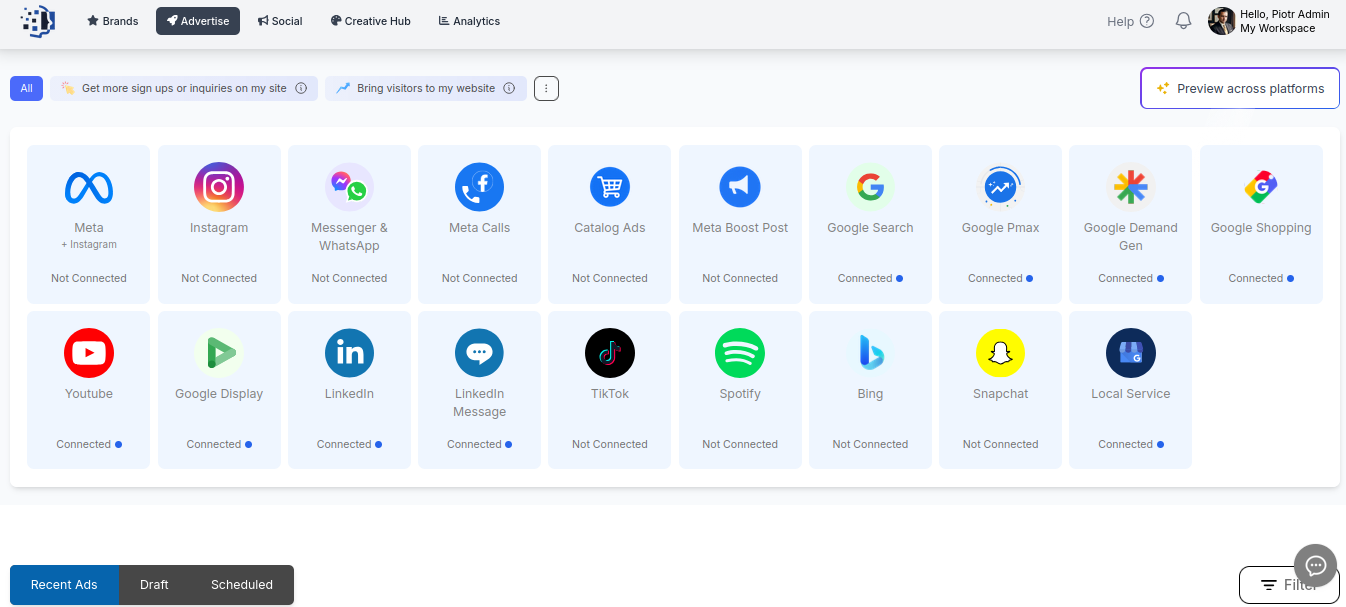
Take control of your digital advertising today and say goodbye to wasted budget and guesswork. Discover how to boost your ROI with smarter targeting and AI-driven campaign automation at Rekla.AI. Explore more about advanced audience targeting strategies and see firsthand how simple it is to launch and optimize campaigns tailored to your unique business needs. Start your journey to efficient advertising now.
Perguntas frequentes
What are ad targeting strategies and why are they important?
Ad targeting strategies involve showing ads to specific audiences based on their characteristics, behaviors, interests, or demographics. They are important because they ensure that advertising budgets are spent on individuals most likely to convert, leading to lower acquisition costs and higher ROI.
How does AI improve ad targeting precision?
AI improves ad targeting by analyzing large datasets to identify patterns in consumer behavior that humans may miss. It enables continuous adjustments to targeting in real-time, resulting in significant improvements in cost per acquisition and overall campaign performance.
What are the main types of audience segmentation methods?
The main types of audience segmentation methods include demographic, behavioral, psychographic, and micro-segmentation. Each method focuses on different factors that help tailor advertising messages to resonate with specific audience segments effectively.
What common mistakes should I avoid in ad targeting?
Common mistakes include targeting too broadly or too narrowly, ignoring consumer privacy concerns, over-segmenting audiences without sufficient resources, allowing ad fatigue, and failing to continuously test and optimize campaigns. These mistakes can waste advertising spend and hinder campaign effectiveness.
 English
 English (UK)
 Polski
 Deutsch
 Español
 Français
 Português
 Svenska
 Dansk
Dansk Nederlands