

Finding time to manually manage digital ads while growing your online store can feel impossible. As an ambitious European e-commerce owner, understanding how programmatic advertising automates real-time ad buying empowers you to reach the right customers faster and with less hassle. This guide gives you clear and practical insights into the core concepts, key platforms, and real benefits of automated advertising so you can scale your budget confidently and compete on equal footing with larger brands.
Indholdsfortegnelse
- Defining Programmatic Advertising Fundamentals
- Key Types of Programmatic Buying Models
- How Automated Ad Auctions Operate
- Real-World Applications For Small Businesses
- Common Pitfalls And Cost Considerations
Vigtige pointer
| Punkt | Detaljer |
|---|---|
| Programmatisk annoncering | This method automates ad buying and selling in real-time, enhancing ad placement efficiency based on user data and behavior. |
| Buying Models | Understand the four programmatic buying models—open auction, private auction, programmatic guaranteed, and direct deals—to choose the best fit for your campaign goals. |
| Optimization Strategy | Regularly monitor and manually optimize campaigns to prevent budget wastage due to overreliance on algorithms and bid price volatility. |
| Målrettet præcision | Leverage programmatic advertising to achieve precise geographic targeting and reduce customer acquisition costs for small businesses. |
Defining Programmatic Advertising Fundamentals
Programmatic advertising is the automated buying and selling of digital ads in real-time using algorithms and machine learning. Instead of manually negotiating ad placements with publishers, your ads are placed automatically based on user behavior, demographics, and context. This automation delivers your message to the right person at the right moment.
Traditional digital advertising requires back-and-forth negotiations, paperwork, and human oversight. Programmatic advertising eliminates these friction points by using software to evaluate thousands of ad opportunities in milliseconds and decide whether each one matches your target audience. The speed and precision are unmatched.
Here’s what makes programmatic different from traditional ad buying:
- Real-time bidding: Your ad competes in auctions and wins placement automatically when conditions match your campaign goals
- Data-driven decisions: Algorithms analyze user signals like browsing history, location, and device type to find your ideal customers
- Skalerbarhed: You can run campaigns across dozens of platforms simultaneously without manual setup for each one
- Cost efficiency: You only pay for placements that actually reach your target audience, reducing wasted ad spend
Programmatic advertising’s automated buying process has transformed how brands connect with consumers online. For a small e-commerce business in Europe, this means you can compete with larger brands by targeting customers more precisely and adjusting campaigns instantly based on performance.
The technology behind programmatic relies on three core components working together. First, demand-side platforms (DSPs) are the software where advertisers manage campaigns and set targeting rules. Second, supply-side platforms (SSPs) are where publishers offer ad space. Third, ad exchanges are the marketplaces where DSPs and SSPs connect to complete transactions in real-time.
This tri-part system creates transparency you don’t get with traditional buying. You can see exactly where your ads appear, who’s seeing them, and what they cost. That visibility helps you optimize budgets and improve ROI continuously.
Here’s a summary of the main platforms and their key functions in the programmatic advertising ecosystem:
| Platform Type | Main Role | Who Uses It | Indvirkning på forretningen |
|---|---|---|---|
| Demand-Side Platform (DSP) | Buys ad inventory automatically | Advertisers and agencies | Enables precise, data-driven targeting |
| Supply-Side Platform (SSP) | Sells publisher ad space | Publishers and media owners | Maximizes ad revenue through automation |
| Ad Exchange | Matches ad buyers and sellers | Both advertisers and publishers | Ensures efficient, real-time auctions |
Real-time bidding means your ads compete automatically for placements that match your audience criteria, eliminating manual negotiations and human delays.
For European e-commerce businesses, programmatic advertising offers a critical advantage: geographic precision. You can target customers in specific countries, regions, or cities and adjust messaging for local preferences. You can also optimize for different languages and cultural nuances without creating separate campaigns.
Profftip: Start by identifying which of your target customer segments spend time on which platforms—TikTok, Facebook, YouTube, etc.—then use programmatic tools to test which combinations deliver the lowest cost-per-acquisition before scaling your budget.
Key Types of Programmatic Buying Models
Programmatic buying comes in four main flavors, each offering different levels of control, pricing, and access. Understanding which model fits your campaign goals is critical for maximizing ROI and managing your ad budget efficiently.
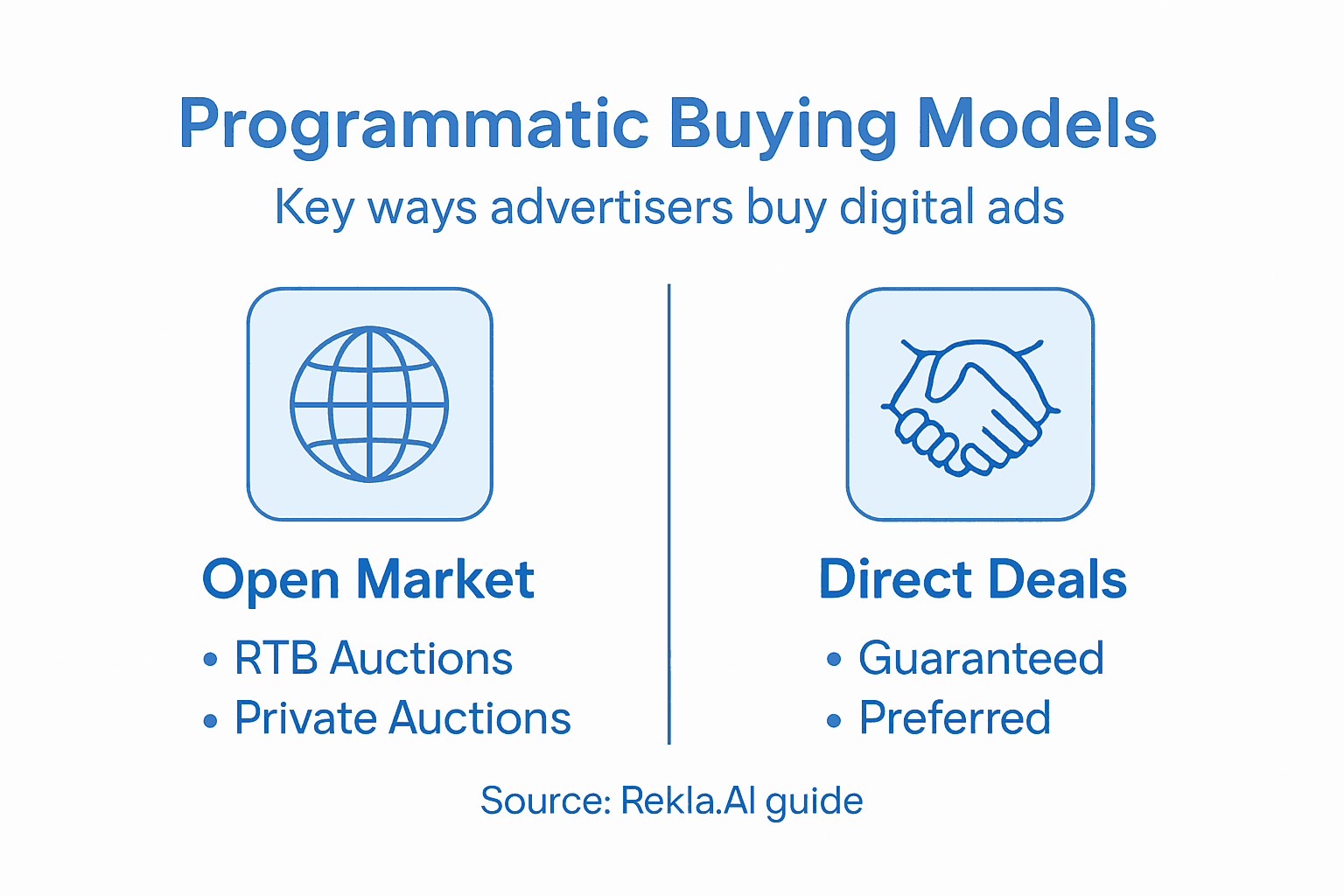
The first model is open auction, also called real-time bidding (RTB). Your ads compete in an open marketplace where thousands of advertisers bid for the same inventory simultaneously. You set your maximum bid price, and if you win the auction, your ad appears instantly. This model offers the widest inventory access and lowest prices, but you have less control over where your ads show.

The second is private auction, also called preferred deals. Here, publishers invite a select group of advertisers to bid on premium inventory before it goes to the open market. You get better placements and more control than open auctions, but fewer opportunities and slightly higher prices. This model works well when targeting specific publisher audiences.
Programmatic guaranteed is the third option. You and the publisher negotiate a fixed price and guaranteed volume upfront, similar to traditional direct buys but executed automatically. This removes auction competition entirely. You know exactly what you’ll pay and how many impressions you’ll receive, making budget forecasting easier.
The fourth is direct deals. These are agreements between buyers and sellers negotiated offline but executed programmatically. Pricing and terms are negotiated directly with publishers, giving you maximum control and access to premium inventory at agreed-upon rates.
Here’s how these models compare:
- Open auction: Lowest cost, widest reach, least control over placement quality
- Private auction: Better inventory quality, select access, moderate pricing
- Programmatic guaranteed: Fixed costs, guaranteed volume, predictable results
- Direct deals: Maximum control, premium inventory, negotiated pricing
For European e-commerce businesses, the choice depends on your campaign stage. Starting out? Open auction gives you scale at lower cost. Growing and want better placements? Private auction offers balance. Running high-priority campaigns? Programmatic guaranteed or direct deals provide certainty.
Most successful campaigns use multiple models simultaneously—budget-conscious campaigns run through open auctions while brand-awareness campaigns use guaranteed inventory.
Many businesses make the mistake of picking one model and sticking with it. The reality is different buying models serve different purposes within the same campaign. Automating ad campaigns across multiple buying models lets you optimize each one independently while maintaining overall campaign efficiency.
Profftip: Test open auction first with a small budget to understand your baseline costs and performance, then layer in programmatic guaranteed deals for your best-performing audience segments to secure inventory and reduce bidding competition.
How Automated Ad Auctions Operate
Automated ad auctions happen in milliseconds, invisible to everyone except the technology running them. When someone visits a website or opens an app, a publisher instantly triggers an auction for that ad space. Your demand-side platform (DSP) receives an invitation to bid, evaluates the opportunity against your targeting criteria, and decides whether to compete within fractions of a second.
Here’s what happens during the auction process:
- User visits a webpage or opens an app
- Publisher’s server sends impression data to the ad exchange
- Exchange broadcasts the auction invitation to demand-side platforms
- Your DSP analyzes user data, context, and your campaign rules
- DSP submits your bid if conditions match your target audience
- Exchange awards impression to highest bidder
- Winning ad displays instantly
This entire sequence takes 100 milliseconds or less. Your bidding strategy doesn’t rely on manual decisions but on algorithms that analyze real-time bidding opportunities against predefined rules you’ve set.
Den supply-side platform (SSP) is the publisher’s tool. It manages their ad inventory and sends auction invitations. The ad exchange acts as the marketplace middleman, broadcasting opportunities and managing the auction mechanics. Your demand-side platform (DSP) is your bidding engine, automatically submitting offers based on your campaign settings.
Your DSP uses data signals to make split-second decisions:
- Audience data: Demographics, interests, browsing history, purchase behavior
- Contextual data: Page content, device type, location, time of day
- Performance data: Historical conversion rates from similar placements
- Bid strategy: Your maximum bid price and bidding algorithm preferences
Think of it like an auction house, but instead of humans raising their hands, computers bid simultaneously on thousands of items per second. The highest valid bid wins instantly.
Automated auctions optimize for your goals in real-time—if your algorithm notices a placement typically converts better, it bids higher for similar opportunities automatically.
Most e-commerce businesses underestimate how much their DSP is working for them. The platform continuously adjusts bids, tests new audience segments, and learns from winning versus losing auctions. This means automating ad campaigns with proper setup generates better results than manual buying ever could.
Price discovery happens automatically too. Your DSP doesn’t just bid randomly; it learns the market clearing price for different audience segments and adjusts accordingly. Over time, auctions become more efficient as algorithms understand which placements deliver genuine value.
Profftip: Set your DSP to track which auction characteristics lead to conversions, then create custom bidding rules that bid more aggressively on those specific auction types rather than treating all impressions equally.
Real-World Applications for Small Businesses
Small e-commerce businesses face a tough reality: compete with larger brands or get left behind. Programmatic advertising levels the playing field by automating what big brands do manually with large teams. You can now compete on precision and speed without the overhead.
Consider a small fashion retailer in Poland selling across Europe. With programmatic, they target customers searching for winter coats in Germany, winter dresses in France, and heavy jackets in Scandinavia—all within a single automated campaign. Each audience sees different products at different price points. Manual buying would require separate campaigns for each region. Programmatic handles it automatically.
A furniture e-commerce business in Spain can use AI-driven programmatic advertising to target homeowners by purchase intent. When someone searches for “living room furniture,” the algorithm identifies them. Your DSP automatically bids for that user across multiple platforms—Facebook, Google, Instagram, YouTube. If they convert on one platform but not another, the algorithm learns and shifts budget accordingly.
Here’s how small businesses benefit from programmatic:
- Præcis målgruppetilpasning: Reach customers by behavior, interests, location, and purchase history
- Reduced wasted budget: Only pay for impressions matching your target audience
- 24/7 optimization: Algorithms adjust bids and placements while you sleep
- Multi-channel consistency: Run coordinated campaigns across 15+ platforms simultaneously
- Rapid testing: Launch A/B tests automatically and scale winners within hours
A UK-based electronics retailer discovered that customers aged 25-34 visiting their site on mobile devices convert 3x better than desktop users. Traditional buying would require manual campaign adjustments. Programmatic made the discovery in days and automatically increased bids for that segment.
Local businesses benefit too. A German outdoor sports retailer can target customers within 50 kilometers of their physical stores, driving foot traffic while also converting online sales. Geographic targeting precision is nearly impossible without programmatic.
Small businesses using programmatic report 40-60% lower customer acquisition costs compared to manual buying while reaching more qualified prospects.
Budget constraints also favor programmatic. You can start with €200/month and scale to €5,000/month as campaigns prove profitable. The system never wastes money on bad placements because algorithms kill underperforming combinations instantly.
The key is starting with practical steps for initiating programmatic campaigns rather than jumping to complex strategies. Focus on one product category, one target audience, and one buying model. Let the algorithm optimize. Once you see results, expand.
Profftip: Start with open auction bidding on your best-converting product category with a small budget, monitor results for 2 weeks, then layer in programmatic guaranteed deals for your top-performing audience segments to secure inventory at predictable costs.
Common Pitfalls and Cost Considerations
Programmatic advertising isn’t a set-it-and-forget-it solution. Businesses that launch campaigns without understanding costs and common mistakes often waste thousands of euros within weeks. The automation is powerful, but it requires oversight.
The biggest mistake small businesses make is trusting the algorithm too much. You set your budget, configure targeting, and assume the platform will optimize perfectly. Reality is messier. Algorithms optimize for clicks or impressions, not necessarily for profitable conversions. If your settings are wrong, the algorithm will efficiently waste your budget on the wrong audience.
Bid price volatility is another hidden cost. In open auctions, prices fluctuate based on competition. During peak shopping hours, CPMs (cost per thousand impressions) can spike 200-300%. A campaign running at €0.50 per click at midnight might cost €1.50 per click at 6 PM. Budget controls help, but prices vary unpredictably across platforms and regions.
Common pitfalls include overreliance on automation without sufficient manual testing and optimization. Here’s what to watch for:
The following table highlights common pitfalls in programmatic advertising and strategies to avoid them:
| Faldgrube | Typical Effect | Prevention Strategy |
|---|---|---|
| Overreliance on automation | Budget wasted on unprofitable clicks | Regular manual optimization checks |
| Bid price volatility | Costs surge unpredictably | Set bid caps and monitor CPMs |
| Poor audience definition | Low conversion rates | Use data to refine segments |
| Platform fees | Reduced net ROI | Review platform cost breakdowns |
| Ad fraud exposure | Paying for non-human traffic | Implement third-party fraud detection |
- Ad fraud: Bots inflate impressions, eating your budget without generating real users
- Hidden platform fees: Some platforms charge 10-30% on top of auction prices
- Poor audience definition: Targeting too broadly wastes spend; targeting too narrowly limits scale
- Unoptimized landing pages: Traffic arrives but doesn’t convert, wasting acquisition costs
- Ignoring geographic variations: Cost per conversion differs dramatically by country and region
A German e-commerce business noticed their customer acquisition cost doubled in one month. Investigation revealed their algorithm was bidding aggressively on audiences in expensive markets (Switzerland, Scandinavia) instead of profitable ones (Poland, Hungary). The algorithm doesn’t know which markets are profitable unless you tell it.
Data privacy regulations add complexity too. GDPR, cookie restrictions, and iOS privacy changes limit audience targeting precision. Fewer data signals mean broader targeting, which increases wasted spend. European businesses especially face these constraints.
Budget wastage accelerates when algorithms optimize without clear conversion tracking—you’re paying for clicks or impressions, not actual business results.
Cost management requires active monitoring. Check campaign performance at least twice weekly. Monitor cost per conversion, return on ad spend (ROAS), and spend velocity. If costs spike suddenly, pause and investigate immediately.
Transparency matters too. Demand detailed reporting showing exactly where your money goes—auction prices, platform fees, fraud detection rates, and performance by audience segment. Opaque reporting hides inefficiency.
Profftip: Set daily budget caps 20-30% below your actual spend tolerance, then monitor the first week intensely to catch price spikes and fraud before they drain your entire monthly budget.
Unlock Smarter Programmatic Campaigns with Rekla.AI
The article highlights the challenges small and medium businesses face in managing programmatic advertising effectively. Key hurdles include controlling costs amid bid price volatility, avoiding wasted budget on underperforming audience segments, and mastering complex real-time bidding strategies. If you want to harness the power of data-driven, automated ad buying without getting lost in overwhelming manual processes, Rekla.AI is your solution. Our AI-powered platform simplifies campaign creation and optimization by using advanced algorithms to target precisely, adjust bids dynamically, and automate multi-channel advertising across platforms like Facebook, Google, TikTok, and YouTube.
Med Rekla.AI you can reduce ad spend waste, improve click-through rates, and continuously optimize budgets and placements based on real-time performance data. Don’t settle for inefficient manual buying when you can let AI handle bidding strategies, audience segmentation, and creative generation with minimal effort while retaining full control over costs and campaign goals.
Discover how easy it is to compete with larger brands and scale your digital ads efficiently with Rekla.AI.
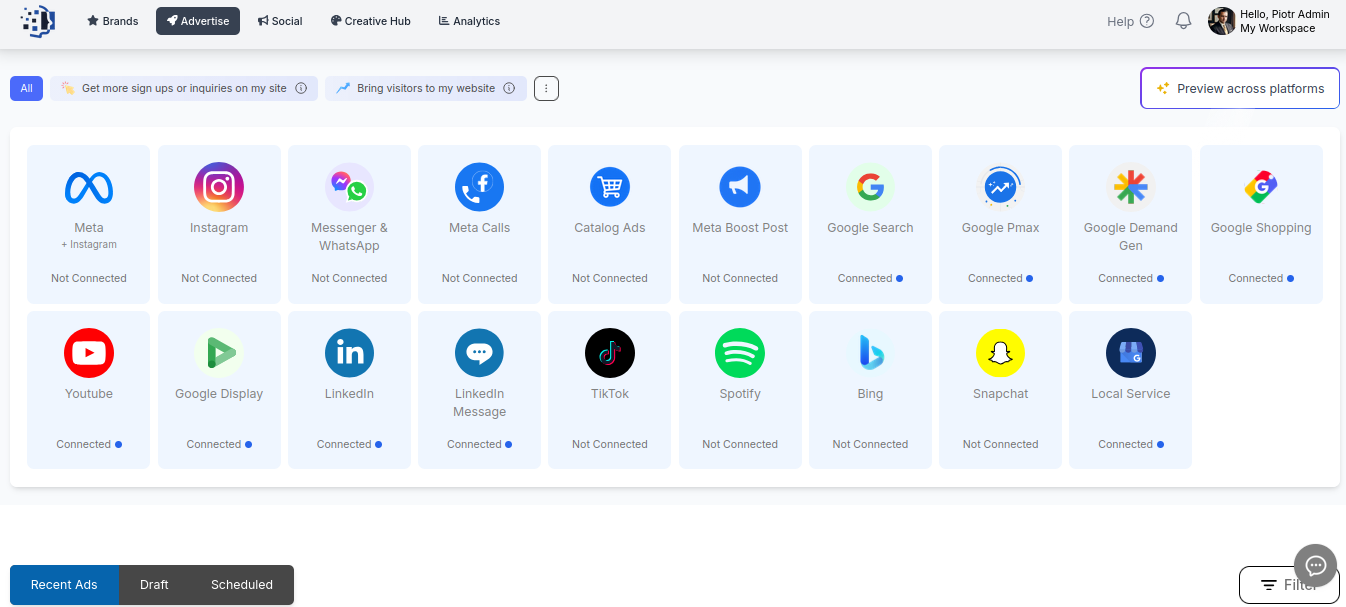
Ready to transform your programmatic advertising and start maximizing your return on ad spend today Visit Rekla.AI to launch smarter campaigns that automatically optimize for your business goals. Learn more about the benefits of automated ad campaign management and see why Rekla is the platform small-to-medium businesses trust for digital advertising success.
Ofte stillede spørgsmål
What is programmatic advertising?
Programmatic advertising refers to the automated buying and selling of digital ads in real-time using algorithms. It replaces manual negotiations with automated software that evaluates ad opportunities based on user behavior, demographics, and context.
How does real-time bidding work in programmatic advertising?
Real-time bidding (RTB) allows ads to compete in auctions for placements automatically. When a user accesses a website, an auction is triggered, and demand-side platforms (DSPs) analyze user data to submit bids. The highest bidder wins the placement almost instantly.
What are the main types of programmatic buying models?
There are four main programmatic buying models: open auction (real-time bidding), private auction, programmatic guaranteed, and direct deals. Each model offers different levels of control, pricing, and access to inventory, allowing advertisers to choose based on their campaign goals.
How do small businesses benefit from programmatic advertising?
Small businesses benefit from programmatic advertising through precise audience targeting, reduced wasted budgets, ongoing optimization during campaigns, and the ability to run multi-channel campaigns efficiently. This allows them to compete effectively with larger brands without needing extensive resources.
Anbefalet
- Grundlæggende om digitale annoncekampagner: Drivkraft for smart ROI
- Grundlæggende om digitale annoncekampagner: Drivkraft for smart ROI
- Hvorfor optimere annoncekampagner: Øg ROI og resultater
- Hvorfor optimere annoncekampagner: Øg ROI og resultater
- Campaign Analytics Guide: Master Data-Driven Success in 2025 – Affinsy Blog | Affinsy
 English
 English (UK)
 Polski
 Deutsch
 Español
 Français
 Português
 Svenska
 Dansk
Dansk Nederlands