
Digital marketers face a persistent challenge: producing engaging ad creatives quickly and affordably. Traditional methods demand significant time and resources, often yielding inconsistent results. Recent data reveals that AI-driven ad creative generation can boost engagement rates by up to 30%, transforming how small and medium-sized businesses approach digital advertising. This article explores how AI automates and optimizes ad content creation, the technologies powering these solutions, and practical steps to implement them successfully.
Table of Contents
- Understanding Ad Creative Generation
- Mechanics of AI Ad Creative Generation
- Performance Impact of AI-Driven Ad Creative
- Common Misconceptions About AI in Ad Creative Generation
- Comparison of AI and Traditional Ad Creative Approaches
- Challenges and Limitations of AI Creative Generation
- Real-World Application and Benefits
- Implementation and Optimization Using AI
- Discover Rekla.AI’s AI-Powered Ad Creative Solutions
Key Takeaways
| Point | Details |
|——-|———||
| AI boosts engagement significantly | AI-generated ads can increase engagement rates by 30% and reduce costs by 25% compared to traditional methods. |
| GPT-4 drives personalization | Advanced AI models create tailored ad content based on audience data, intent, and behavior patterns. |
| Human oversight remains essential | AI augments creativity but requires human review to maintain brand alignment and quality standards. |
| Faster, scalable production | AI generates multiple creative variants 70% faster than manual processes, enabling rapid testing. |
| Integration maximizes results | Combining AI tools with existing workflows and continuous optimization delivers the best outcomes. |
Understanding Ad Creative Generation
Ad creative generation refers to the automated production of advertising content including text, images, video, and dynamic copy variations. This process transforms raw inputs like brand guidelines, product information, and audience data into polished, platform-ready ad assets.
The technology produces several creative formats. Static images serve display campaigns and social feeds. Animated visuals capture attention in stories and reels. Short videos engage audiences on platforms like TikTok and YouTube. Dynamic copy variations test different messaging angles simultaneously.
AI and machine learning revolutionize this process by automating repetitive tasks, personalizing content at scale, and accelerating production cycles. Machine learning refers to systems that improve performance through experience, learning patterns from data without explicit programming. Automation eliminates manual content assembly, freeing marketers to focus on strategy and refinement.
Key capabilities enabled by AI include:
- Generating dozens of ad variants from a single brief in minutes
- Personalizing messaging based on demographic, behavioral, and contextual signals
- Adapting creative formats automatically for different platforms and placements
- Testing variations systematically to identify top performers quickly
- Reducing reliance on expensive design resources and lengthy approval cycles
This shift empowers small marketing teams to compete with larger organizations, producing the volume and variety needed for effective multi-channel campaigns.
Mechanics of AI Ad Creative Generation
Advanced AI models like GPT-4 power modern ad creative generation by processing vast amounts of data to produce highly relevant content. These systems analyze audience characteristics, campaign objectives, and brand guidelines to craft personalized ad elements.
The generation process begins with data inputs. Demographics like age, location, and income level establish basic targeting parameters. Behavioral data including browsing history, purchase patterns, and engagement metrics reveal intent and preferences. Contextual signals such as time of day, device type, and platform inform format and delivery optimization.
AI models such as GPT-4 enable dynamic text generation that customizes ad copy to each user segment based on intent and past behavior, improving relevance. Visual generation tools create complementary imagery, adjusting color schemes, layouts, and focal points to match audience preferences and platform specifications.
Iterative machine learning continuously refines output quality. The system generates multiple creative variants, deploys them in live campaigns, measures performance metrics like click-through rate and conversion rate, then adjusts future outputs based on what works. This cycle repeats automatically, improving effectiveness without manual intervention.
Automated A/B testing accelerates learning. AI platforms can launch dozens of creative combinations simultaneously, quickly identifying winners and reallocating budget accordingly. This approach mirrors how successful brands approach their digital advertising strategy, emphasizing data-driven optimization.
Key technical components include:
- Natural language processing for headline and body copy generation
- Computer vision for image composition and optimization
- Predictive analytics for performance forecasting
- Real-time bidding integration for budget efficiency
Pro Tip: Feed your AI tools diverse, high-quality data representing your actual customer base. Narrow or biased inputs produce repetitive, less effective creatives. Include various demographic segments, successful past campaigns, and clear brand voice examples to maximize output quality and minimize algorithmic bias.
Performance Impact of AI-Driven Ad Creative
Quantifiable results demonstrate the business value of AI-generated ad creatives. Research shows engagement rates improve by up to 30% when AI personalizes messaging and visual elements based on audience data. Cost efficiency gains are equally impressive, with cost-per-click reductions of approximately 25% in multi-platform campaigns.
Conversion rates benefit from enhanced relevance. When ads speak directly to user needs and preferences, prospects move through the funnel faster. The precision of AI-driven targeting and creative matching reduces wasted impressions on uninterested audiences.
The table below compares average performance metrics between traditional manual ad creation and AI-generated approaches:
| Metric | Traditional Ads | AI-Generated Ads | Improvement |
|---|---|---|---|
| Engagement Rate | 2.1% | 2.8% | +30% |
| Cost-Per-Click | $1.20 | $0.90 | -25% |
| Conversion Rate | 3.5% | 4.6% | +31% |
| Production Time | 5 days | 1.5 days | -70% |
30% higher engagement rates with AI-generated ad creatives
These improvements compound over time. Faster production enables more frequent testing. Lower costs free budget for expanded reach. Higher conversion rates improve return on ad spend directly. Together, these factors transform campaign economics, making sophisticated advertising accessible to businesses with limited resources.
The connection between creative quality and digital ad optimization and ROI becomes clear when you measure performance systematically. AI removes guesswork, replacing intuition with data-driven decisions that consistently outperform manual approaches.
Common Misconceptions About AI in Ad Creative Generation
Several myths prevent marketers from fully embracing AI tools. Understanding reality helps you implement these technologies effectively and avoid disappointment.
Myth: AI replaces all human creativity. Reality: AI assists and augments human creativity, handling repetitive tasks and generating options quickly. Strategic direction, brand voice, and final approval remain human responsibilities. The best results come from collaboration between AI efficiency and human judgment.
Myth: AI-generated ads are instantly perfect. Reality: Initial outputs require review and refinement. AI produces solid starting points, not finished masterpieces. You must test variants, gather performance data, and iterate based on results. Quality improves as the system learns from your feedback and campaign outcomes.
Myth: AI creatives work well regardless of data quality. Reality: Output quality directly reflects input quality. Limited, biased, or outdated data produces narrow, repetitive creatives that fail to resonate with diverse audiences. Invest time in preparing comprehensive, representative datasets that capture your brand voice and customer diversity.
These misconceptions arise from oversimplified marketing claims and misunderstanding of how machine learning works. AI excels at pattern recognition, variation generation, and optimization at scale. It struggles with nuance, cultural sensitivity, and strategic pivots requiring business context.
Recognizing these limitations helps you assign tasks appropriately. Let AI handle volume, speed, and data processing. Reserve human attention for strategy, creativity, and oversight. This division of labor maximizes both efficiency and quality.
Comparison of AI and Traditional Ad Creative Approaches
Understanding practical differences between manual and AI-driven creative development clarifies when and how to use each method.
Traditional approaches rely on design teams, copywriters, and iterative approval processes. Each creative requires individual attention, limiting output volume. Personalization happens at broad segment levels due to resource constraints. Production timelines stretch across days or weeks. Costs scale linearly with creative quantity.
AI-driven generation inverts this model. Systems produce dozens of variants simultaneously. Personalization reaches individual user levels. Production completes in hours instead of days. Marginal costs for additional creatives approach zero after initial platform setup.
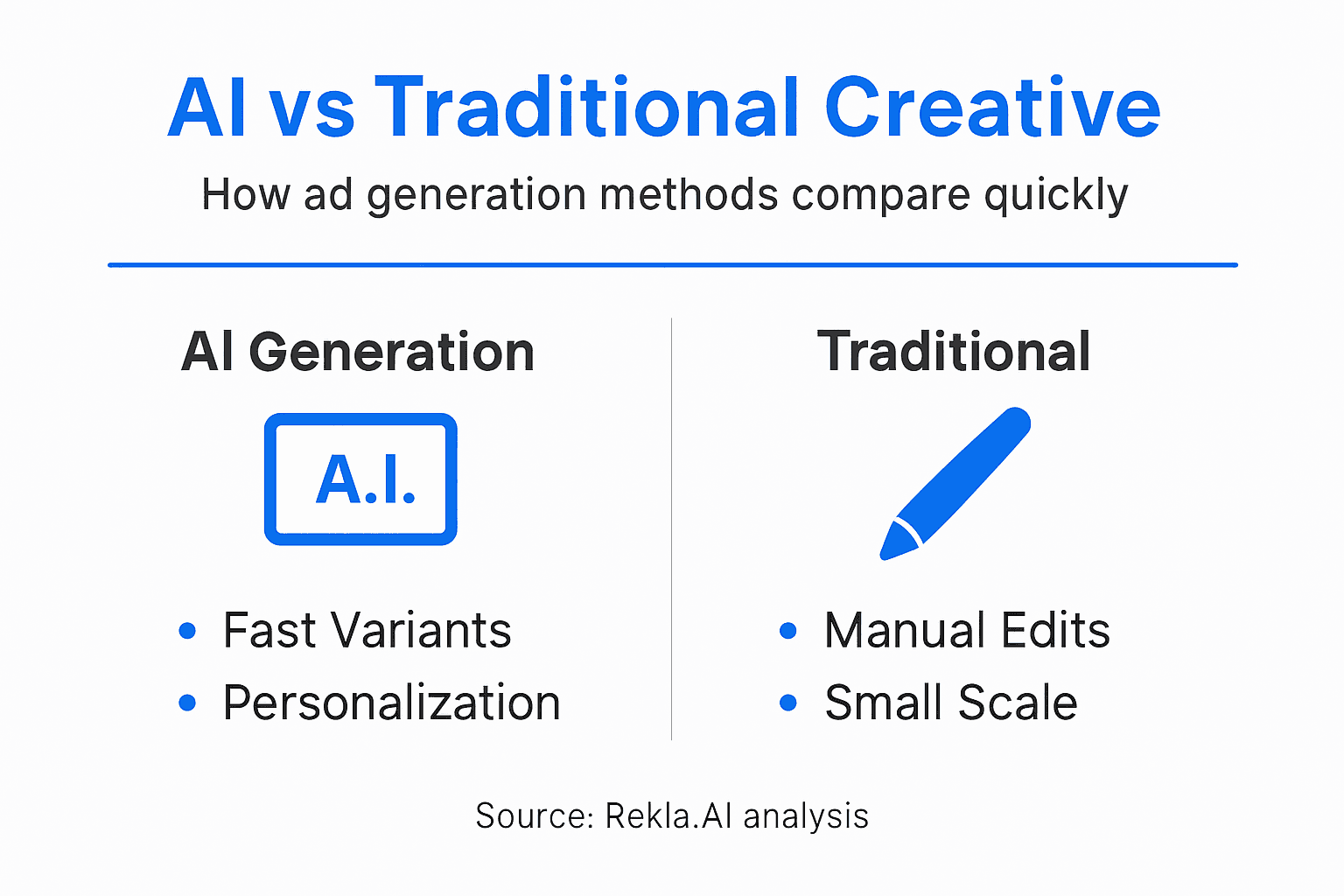
The table below summarizes key operational differences:
| Factor | Traditional Method | AI-Driven Method |
|---|---|---|
| Production Time | 3-5 days per campaign | 4-6 hours per campaign |
| Cost Per Creative | $200-500 | $10-50 |
| Personalization Depth | Broad segments | Individual users |
| Variants Generated | 3-5 per campaign | 50-100+ per campaign |
| Optimization Speed | Weekly manual review | Real-time automated |
| Scalability | Limited by team size | Virtually unlimited |
AI workflows integrate testing and multi-platform deployment seamlessly:
- Automated variant generation across headlines, images, and calls to action
- Simultaneous deployment to Facebook, Google, LinkedIn, and other platforms
- Real-time performance tracking with automatic budget reallocation
- Continuous learning that improves future creative recommendations
- Easy scaling from single campaigns to coordinated multi-channel strategies
Pro Tip: Don’t abandon your creative team when adopting AI. Instead, redirect their expertise toward strategic planning, brand development, and quality oversight. Combine AI speed with human judgment for campaigns that perform well and maintain brand integrity.
Challenges and Limitations of AI Creative Generation
Responsible AI adoption requires understanding potential pitfalls and implementing safeguards.
Bias poses a significant risk. If training data overrepresents certain demographics or perspectives, AI outputs will reflect and amplify those limitations. An AI trained primarily on ads targeting young urban professionals might generate irrelevant content for rural or older audiences. Regular audits of training data and output diversity help mitigate this problem.
Data dependency affects performance quality. AI systems require substantial, diverse datasets to produce effective creatives. Startups and new brands with limited historical data may see less impressive initial results. The solution involves supplementing proprietary data with industry benchmarks and competitor analysis where possible.
Human oversight remains non-negotiable. Automated systems occasionally produce nonsensical combinations, culturally insensitive content, or off-brand messaging. Every AI-generated creative should undergo human review before publication, particularly when entering new markets or addressing sensitive topics.
Common pitfalls include:
- Overreliance on automation without strategic input or performance monitoring
- Ignoring creative fatigue as audiences tire of similar AI-generated patterns
- Neglecting platform-specific best practices in favor of one-size-fits-all approaches
- Failing to refresh training data, causing outputs to become stale and repetitive
- Skipping A/B tests that validate AI recommendations against human-created alternatives
Mitigation strategies focus on balance. Use AI for scale and efficiency while maintaining human involvement in strategy, oversight, and continuous improvement. Diversify training datasets intentionally. Monitor performance metrics closely to catch degradation early. Treat AI as a powerful tool requiring skilled operation, not a replacement for marketing expertise.
Real-World Application and Benefits
Concrete examples demonstrate how small and medium-sized businesses achieve measurable gains through AI creative generation.

A digital fitness brand reduced cost-per-acquisition by 28% after implementing AI-generated ad creatives. The platform produced 60 variants testing different headlines, images, and calls to action. Automated A/B testing identified top performers within 72 hours. The winning combinations emphasized transformation stories and used action-oriented imagery, insights the marketing team applied to future campaigns.
An e-commerce retailer selling home goods increased conversion rates by 32% using AI personalization. The system analyzed browsing behavior and purchase history to generate product-specific ads featuring items each user had viewed. Dynamic copy adjusted messaging based on cart abandonment status, price sensitivity signals, and seasonal trends.
A B2B software company scaled campaigns across 12 platforms simultaneously using AI automation. Previously, their small team managed only Facebook and Google due to resource constraints. AI creative generation enabled expansion to LinkedIn, Twitter, Reddit, and industry-specific platforms without additional hiring. Multi-channel presence increased qualified leads by 45%.
Key benefits realized across these scenarios:
- Dramatic reduction in time from concept to launch, enabling agile response to market changes
- Cost savings redirected toward expanded reach and audience testing
- Performance improvements through systematic optimization impossible at manual speeds
- Competitive advantages for small teams competing against larger, better-resourced rivals
- Data-driven insights that improve overall marketing strategy beyond just ad creative
These successes share common elements: clear objectives, quality input data, human oversight, and commitment to iterative improvement. AI tools amplify good strategy but cannot compensate for fundamental marketing weaknesses.
Implementation and Optimization Using AI
Practical steps guide successful integration of AI ad creative generation into your marketing workflow.
- Collect and analyze foundational data. Gather audience demographics, behavioral patterns, past campaign performance, and competitor benchmarks. Organize this information to feed AI systems accurately. Include successful ad examples that reflect your brand voice and visual identity.
- Select and configure AI platforms. Evaluate tools based on platform compatibility, personalization depth, integration capabilities, and cost structure. Configure brand guidelines, targeting parameters, and performance objectives within the system. Most platforms require initial training periods to learn your specific needs.
- Generate and deploy creative variants. Use AI to produce multiple headlines, images, and copy variations for each campaign. Deploy these across target platforms with appropriate budget allocations. Start with smaller test budgets to validate performance before scaling investment.
- Implement automated testing and optimization. Configure A/B tests comparing AI-generated variants against each other and against human-created controls. Enable dynamic budget allocation that shifts spending toward top performers automatically. Set performance thresholds that trigger alerts for human review.
- Conduct regular human review and refinement. Schedule weekly reviews of campaign performance, creative quality, and audience feedback. Identify patterns in top-performing creatives and update AI inputs accordingly. Remove underperformers and refresh creative pools to prevent audience fatigue.
Integration with existing digital advertising strategy frameworks enhances results. AI creative generation works best as part of comprehensive campaigns that include proper audience research, clear conversion paths, and post-click optimization.
Follow proven digital campaign setup practices when launching AI-powered initiatives. Proper tracking implementation, conversion pixel configuration, and attribution modeling ensure you capture the full value of performance improvements.
Learn advanced techniques to boost advertising ROI with AI by combining creative optimization with bidding strategies, audience expansion, and cross-platform coordination.
Pro Tip: Refresh your AI inputs monthly by feeding back performance data and successful creative elements. This creates a virtuous cycle where the system continuously learns what works for your specific audience and brand. Don’t let your AI run on stale data, even if current performance seems adequate.
Discover Rekla.AI’s AI-Powered Ad Creative Solutions
Ready to transform your advertising with intelligent automation? Rekla.AI delivers comprehensive tools that simplify creative generation, campaign management, and performance optimization across 15+ platforms.
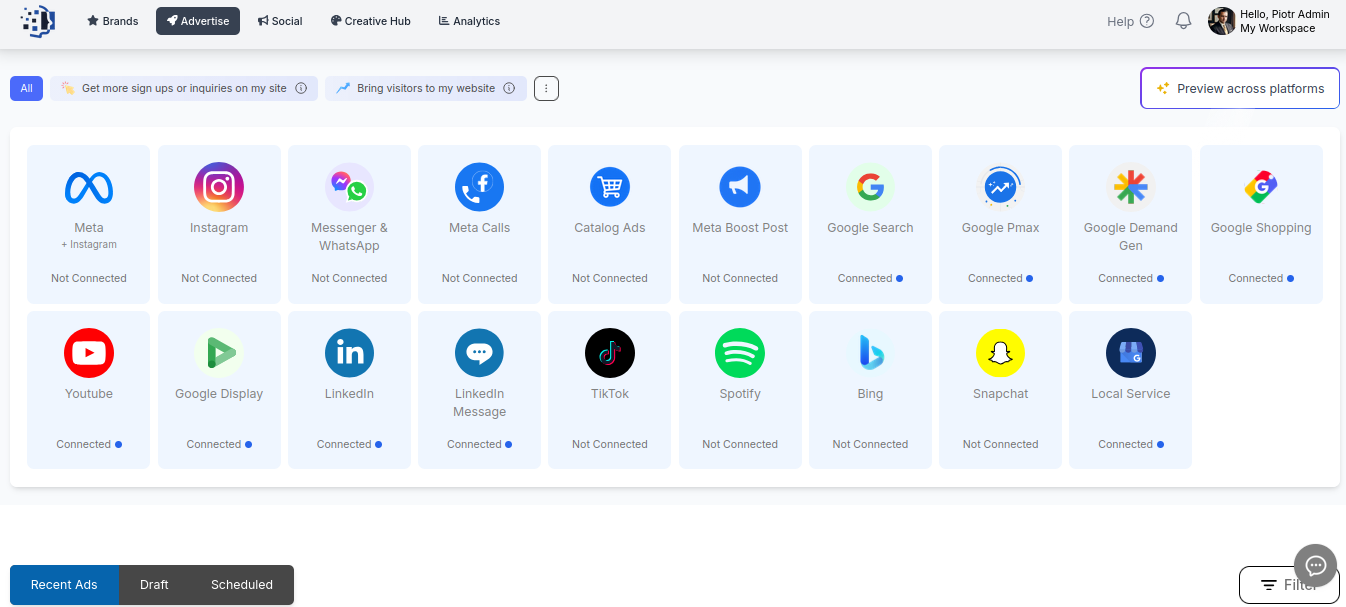
Our platform combines advanced AI models with intuitive interfaces designed for marketers, not data scientists. Generate hundreds of ad variants automatically. Deploy campaigns to Facebook, Google, TikTok, LinkedIn, and more with single-click simplicity. Monitor performance in real-time and let AI optimize budgets toward your best-performing creatives.
Small marketing teams achieve enterprise-level results through Rekla.AI’s automation. Reduce costs, accelerate production, and improve engagement using the same digital advertising strategy principles discussed in this article. Learn how to reduce ad costs with AI while improving outcomes. Explore how businesses generate hundreds of ad creatives with AI using our latest features. Transform your digital advertising today.
What Is Ad Creative Generation? Frequently Asked Questions
What makes AI-generated ad creatives different from manually produced ones?
AI creatives leverage machine learning to personalize content at scale based on audience data, while manual creatives rely on human designers creating limited variants. AI produces dozens of options quickly, tests them systematically, and optimizes automatically. Manual processes offer deeper creative nuance but cannot match AI speed or personalization depth.
Do AI creative tools require technical expertise to use effectively?
Modern AI ad platforms feature user-friendly interfaces designed for marketers without technical backgrounds. You provide brand guidelines, audience information, and campaign objectives through simple forms. The system handles complex AI operations behind the scenes. Basic digital marketing knowledge suffices, though understanding performance metrics helps you optimize results.
How does AI adapt creatives across different platforms like social media and search?
AI systems maintain platform-specific format requirements, character limits, and best practices in their generation logic. The same core message automatically adjusts to Facebook’s visual focus, LinkedIn’s professional tone, or Google’s search intent matching. This ensures native ad experiences that perform well on each platform without manual reformatting.
What best practices maintain creative quality when using AI?
Provide diverse, high-quality training data representing your actual audience. Review all AI outputs before publication to catch errors or off-brand content. Refresh creative pools regularly to prevent audience fatigue. Combine AI-generated variants with human-created concepts to balance efficiency and originality. Monitor performance metrics closely and feed successful patterns back into the system.
What initial investment and timeline should I expect for AI creative tools?
Most AI platforms offer subscription pricing from $200-1000 monthly depending on features and scale. Initial setup takes 1-2 weeks including data integration, brand configuration, and team training. Meaningful performance data emerges within 3-4 weeks of active campaigns. Full optimization and ROI improvements typically manifest over 2-3 months as the system learns your specific audience and business context.
 English
 English (UK)
 Polski
 Deutsch
 Español
 Français
 Português
 Svenska
 Dansk
Dansk Nederlands